

If you’re planning indoor glass railings in an Ontario home, you only need to understand a few code “pressure points” to avoid costly surprises: guard height, openings, the stair triangle gap, and a real handrail plan on stairs. Get those right early and the rest becomes a design choice, not an inspection problem.
This guide stays homeowner-friendly. It’s not legal or engineering advice. Ontario Building Code (OBC) requirements can depend on context, and your local authority having jurisdiction (AHJ) has the final say. Use this as a practical checklist before glass is cut.
What Code Cares About Most
Ontario’s guard and handrail rules aren’t trying to police your style. They’re trying to prevent falls, prevent children from passing through openings, and make stairs safe to use every day. When you understand what the rules are protecting against, the details make more sense.
Glass can help because it creates a continuous barrier. However, glass doesn’t “auto-pass” code. The system still needs correct height, correct openings at edges, and a handrail strategy that makes sense on real stairs.
What A “Guard” Is
A guard is a barrier that stops someone from falling where there’s a drop. Code cares about three practical things: how high it is, how big the openings are, and whether it can resist normal loads without unsafe movement.
That definition matters because people mix up guards and handrails. Glass is often the guard. The handrail is a separate “use the stairs safely” element in many situations. Treat them as two functions, not one product.
The Three Things That Cause Most Problems
Most problems come from three issues: the guard isn’t tall enough for the location, openings are too large (especially near stairs), or the stair handrail plan gets ignored until the end. These aren’t “tiny technicalities.” They’re the items inspectors and homeowners notice first.
The frustrating part is that these problems usually show up late, after finishes are in and timelines feel tight. The fix is simple: plan the guard and handrail together early, then template once finishes are confirmed.
Guard Height Basics For Homes
Guard height is one of the first things people ask about, and for good reason. Height is easy to measure, easy to inspect, and hard to “hide” if it’s wrong. It also affects how the railing feels in daily use.
In practice, interior guard heights in homes often follow a common benchmark, while other locations (like exterior edges) may require taller guards. Don’t guess from photos. Confirm based on your actual condition and the applicable OBC rules.
Common Interior Guard Heights
In many Ontario home interiors, you’ll hear a common interior guard height benchmark around 900 mm. In other conditions, including many exterior situations, you’ll often see 1,070 mm used as a benchmark. Treat these as common reference points, not a universal guarantee.
The smarter approach is to use those benchmarks to ask the right question: “What guard height applies here?” Your stair type, landing condition, and drop can change what applies. When you plan early, you avoid building something that looks right but measures wrong.
Where Homeowners Get Tripped Up
Renovations create the most height mistakes. A new floor build-up changes finished floor level. New stair nosings change edge geometry. Drywall and trim can shift how you measure at walls and returns.
People also miss the difference between a stair condition and a landing edge. A clean glass run might look continuous, but the measurement points can differ. This is why we confirm conditions on site instead of relying on a “standard height” assumption.
Openings Rules
Openings are where glass railings usually shine, but they’re also where detail work matters. The goal is simple: don’t allow openings big enough for a child to pass through or get stuck. Code expresses that goal using ball or sphere limits.
For homeowners, the main takeaway is not the theory. It’s where openings sneak in: at the bottom edge, at returns, and at the stair triangle.
The 100 mm Rule
A common Ontario benchmark is that guard openings should not allow a 100 mm sphere to pass through. In other words, that means gaps should be small enough that a child can’t slip through.
Glass panels help because the middle of the guard becomes a solid sheet. But openings still matter at panel edges, where glass meets posts or walls, and especially at the base.
The Stair Triangle Rule (Why 150 mm Exists)
Stairs create a special opening zone where the tread, riser, and the bottom of the guard meet. That geometry can form a triangle-shaped gap even when everything else looks tight. A common Ontario benchmark for that stair triangle gap is 150 mm.
This is one of the most common “surprise” issues because people focus on the glass and forget the stair geometry beneath it. If the bottom edge is detailed poorly, the triangle grows. Good planning prevents it.
How Glass Helps (And When It Doesn’t)
Glass helps because it removes “picket spacing” problems from the middle of the guard. You’re not measuring dozens of gaps. You’re controlling a few critical boundaries instead.
However, glass can still fail the opening intent if base details are sloppy. A tall shoe with awkward end gaps, a return that leaves a strange opening near a wall, or a stair edge with inconsistent nosings can all create openings that don’t look bad until someone measures them.
Handrails On Stairs (The Requirement People Forget)
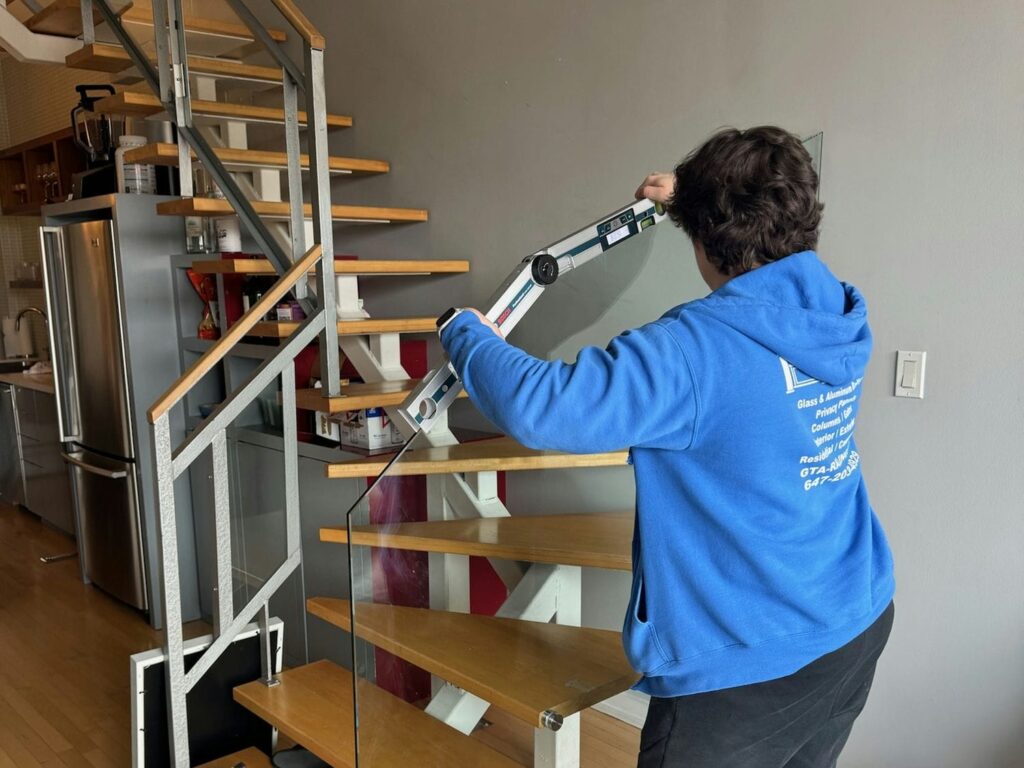
Stairs are where people fall. That’s why handrail planning matters so much. A glass guard can look perfect and still leave you with an awkward or non-functional stair grip line if you didn’t plan the handrail early.
A Guard And A Handrail Are Not Always The Same Thing
A guard prevents a fall off the edge. A handrail helps you use the stairs safely. They overlap sometimes, but they are not automatically the same item.
With glass, this gets confusing because the glass reads like the “railing.” But most people don’t want to grip glass. You want a comfortable, continuous line that guides your hand naturally. That’s why the handrail plan deserves its own decision.
What A “Good” Handrail Strategy Looks Like
A good handrail strategy feels natural. It gives you a continuous grip line where your hand wants to be. It doesn’t force you to grab glass or awkward edges.
It also looks clean. The best results keep the handrail slim and intentional, so it supports the architecture rather than dominating it. If you plan this early, you can keep both safety and aesthetics without late-stage compromises.
Where To Go Deeper
If you want a deeper, practical breakdown of grip profiles, continuity, and how to keep handrails minimal with glass, use our dedicated guide: handrail options for indoor glass railings.
Anti-Climb Intent (Especially Important With Kids)
Anti-climb intent is simple: don’t create a ladder at a dangerous edge. Many homeowners only think about this after install, when they see how kids interact with stairs and landings. It’s better to think about it early.
Glass railings can be a strong choice here because they remove the “rungs” that pickets and horizontal rails can create. But hardware and ledges still matter.
What “Climbable” Means In Real Life
Climbable means a child can use the guard like a ladder. Horizontal members, ledges, and repeated footholds encourage climbing. Even if something is technically strong, it can still be a problem if it invites climbing near a drop.
Glass reduces this risk because the middle is a smooth plane. The danger usually shifts to details: big caps that act like shelves, or hardware layouts that create footholds. Good design keeps those elements minimal.
How Low-Profile Hardware Helps
Low-profile hardware can reduce “ladder-like” cues. Fewer protrusions and fewer horizontal surfaces mean fewer places for a child to step. It can also keep openings and base details cleaner when the system is designed properly.
If you’re comparing shoes, standoffs, clamps, and how each affects stability and clean detailing, start with our hardware guide.
Kid safety is a full topic on its own. This post is about code basics, not a full childproofing checklist. The smart move is to understand the code pressure points here, then apply practical kid-safe design choices in parallel.
If you want the home-focused safety lens, use our childproofing guide as the next step.
Glass Type And Safety (Tempered Vs Laminated)

Finish and glass type are different decisions. Clear or frosted is a visual choice. Tempered or laminated relates to safety behaviour and performance. Many homeowners mix these up, and that’s where confusion starts. The key is to choose glass type as part of the full system: layout, mounting method, and use case.
Finish Choices Don’t Replace Safety Glass
Frosted, etched, tinted, or clear finishes do not change the requirement for safety glass and a properly designed guard system. Finish can help with privacy or glare, but it doesn’t change how the guard must perform.
That’s why we always treat glass as one component in a system. The mounting method, handrail plan, and glass type all work together. If you change one piece late, you often affect the others.
Why Glass Choice Impacts “Feel” And Performance
Homeowners notice rigidity before they notice details. If the system feels springy or loose, it doesn’t feel safe, even if it looks clean. Glass choice affects weight and how the system behaves in real use, which feeds into that “feel.”
This is also why we avoid one-size-fits-all recommendations. A short landing run and a long open-to-below edge are different problems. The right glass and hardware choice depends on what you’re building.
If you want the full plain-English breakdown of tempered vs laminated and what matters at home, use this guide.
The Fast Checklist
This checklist is not a substitute for a proper design review, but it’s a strong first filter. It helps you spot obvious risk points before you spend money on glass or hardware. It also helps you ask better questions when you talk to an installer.
Use it to map the “guard zones” and “handrail zones” in your home. Those two zones overlap, but they are not identical.
Indoor Glass Railing Safety Check In 10 Minutes
- Identify All Drop Edges: Walk the stairs and upper floors. Mark every edge where a fall is possible.
- Check Guard Height At Key Points: Look at the top of the guard along landings and at stair transitions. Note anything that feels low.
- Scan For Openings Along The Run: Look for any gap that looks “big,” especially near walls, posts, and panel ends.
- Inspect The Stair Triangle Area: Look where the tread and riser meet the bottom edge of the guard. This is where triangles form.
- Confirm A Real Handrail Plan: Ask yourself: “Where does my hand go on these stairs?” If the answer is “the glass,” your handrail plan needs work.
- Notice Movement Or Wobble: If anything feels loose, that’s a system and anchoring issue, not a finish issue.
This list doesn’t require special tools. It requires attention. If you can’t confidently answer these items, you’re not ready to finalize glass.
When To Stop Measuring And Call A Pro
Stop and get help if you see a large opening, a loose section, or a stair condition with unclear handrail coverage. Those issues can’t be solved with a nicer finish or a different glass tint. Also call a pro if you’re mid-reno and your floor build-up or stair nosings are still changing. Timing matters. Early templating to unfinished conditions creates expensive rework later.
Here’s The Catch: OBC Depends On Context (And The AHJ Is Final)
If you want a rule that covers every condition, you won’t get it in one blog post. That’s not a failure of the code. It’s reality. Context changes requirements, and Ontario applies rules based on where and how a guard is used.
Why Two Homes Can Have Different Requirements
Two homes can have different requirements because conditions differ: drop height, stair configuration, landings, adjacent walls, and renovation scope. Even “similar” stairs can create different opening zones or require different handrail strategies depending on layout.
That’s why photo-based planning is risky. A beautiful railing on a different stair tells you almost nothing about your openings, your triangle gaps, or your best handrail solution. You still need a site-specific plan.
Use The Official Source For Reference
For the official Ontario Building Code regulation text, use Ontario’s e‑Laws site as the source of truth.
Build It To Code Intent Before Glass Is Cut
Code basics aren’t there to make your home ugly. They’re there to keep edges safe, stairs usable, and openings controlled. When you plan around height, openings, and a real handrail strategy early, you avoid rework and you protect your design.
GTA Railings brings over 15 years of experience, railings made in Canada, and a certified and insured team. We design indoor glass systems to be Ontario Building Code aware and back our work with a 2‑year warranty on materials and workmanship. If you want a clean, compliant path forward, start with our indoor glass railings services.
Frequently Asked Questions
At a high level, code focuses on guard height, openings along the guard, the stair triangle gap at stairs, a safe handrail strategy, and overall system strength. Those factors decide whether the guard prevents falls and prevents unsafe openings.
A common Ontario benchmark is that openings should not allow a 100 mm sphere to pass through. In plain language, gaps must be small enough to reduce child passage risk and prevent dangerous openings.
Stairs can create a triangular opening where the tread, riser, and the bottom of the guard meet. A common Ontario benchmark is a 150 mm limit for that triangle gap, because stair geometry naturally creates larger openings.
Often, yes on stairs. The guard prevents falls off the edge, while the handrail supports safe stair use. A clean glass guard still needs a planned grip line so people don’t grab the glass.
No. Frosted vs clear is a finish choice. It doesn’t change height, openings, handrail needs, or guard performance. Choose finish based on privacy and look, then design the guard to perform.
Yes. Hardware affects base detailing, edge gaps, and rigidity. A low-profile system can look clean and still create unwanted openings if transitions and returns are poorly planned.
Use Ontario’s e‑Laws website for the Ontario Building Code regulation text.