

A commercial patio railing has to take more force than the railing on a house, and if it does not, a failure becomes your problem, not just your installer’s. On a restaurant patio, the guard around the edge usually has to be engineered and signed off by a professional before it goes in. Skip that, and a railing that gives way under a leaning crowd turns into a liability question with your name on it. What that costs depends on the injury, the policy, and the court. Claims can range from about $10,000 for a minor injury to upwards of $20 million for a catastrophic or fatal accident. The practical point is simpler. Building the railing to the commercial load requirements is small and known money. A claim is not. If you are pricing or checking patio railings for a commercial patio, here is what the standard actually asks.
Commercial Patio Railings Carry a Heavier Load Than a House Railing
Here is the part that surprises most owners: most of the load rules are the same for a house and a restaurant patio. The point load, the vertical load, and the panel load do not change. One number does, and it is the one that matters most, the steady horizontal push along the top rail. A metal or glass guard also has to be engineered, which a house railing usually does not.
A Patio Guard Is a Structural Barrier, Not Trim
A guard is not decoration. It is the barrier at the edge of a raised or defined dining area, and its job is to stop a person, a chair, or a crowd leaning on it from going over the edge. Think about how a busy patio actually behaves. People stand at the rail with a drink, lean back, set their weight against it, and sometimes a whole group presses in at once. The guard has to hold all of that without moving.
Here is the catch most people miss. A guard almost never fails in the middle of the rail. It fails at the connection, where the post meets the deck or the slab. That joint is where the force ends up, and a railing that looks perfectly solid can still be weak in exactly that spot.
The Loads a Guard Is Checked Against, and the One That Changes
The code does not check a guard against a single load. It checks it against a few different pushes, and they do not all happen at the same time. There is a steady push spread along the whole top rail. There is one hard shove at a single point. There is a downward load, someone sitting or standing on the rail. And there is a localized push on one panel or picket. You design for whichever is worst at a given spot, and they are not added together.
Three of those four are identical for a house and a restaurant patio. Every guard has to resist a downward load of 1.5 kN/m along the top, a single 1.0 kN push at any point, and a 0.5 kN load on any individual panel or picket over a small area of about 100 mm by 100 mm. None of these have to act at the same moment. Those figures come from a City of Markham building bulletin that restates the provincial code table, and the code itself is the authority behind them.
Residential Versus Commercial: The Number That Changes
So which number moves? The steady horizontal push along the top rail. A home railing, meaning one inside a house or serving no more than two homes, has to take 0.5 kN/m along the top. A commercial patio guard lands in the code’s catch-all category, all other guards, and has to take 0.75 kN/m. Same point load, but half again as much steady push. That is where the Ontario Building Code’s guard requirements for a house deck and a restaurant patio part ways: this one line load.
One caveat is worth stating plainly. The single highest guard number in the code, 3.0 kN/m, is written for grandstands, stadiums, bleachers, and arenas. A restaurant patio guard is not held to that stadium crowd load, but it is held to a higher bar than a house.
| Load on the guard | Residential guard (within or serving up to 2 homes) | Commercial or assembly guard (all other guards) | Why it matters |
| Horizontal push along the top rail | 0.5 kN/m | 0.75 kN/m | The everyday crowd-lean load; 50% higher on a patio, the one number that changes |
| Single point push (top of guard) | 1.0 kN at any point | 1.0 kN at any point | One hard shove; same either way |
| Vertical (downward) load at the top | 1.5 kN/m | 1.5 kN/m | Someone sitting or standing on the rail; same either way |
| Localized push on one panel or picket | 0.5 kN over a small area | 0.5 kN over 100 mm x 100 mm | Infill has to hold on its own; same either way |
These loads are not added together; a guard is designed for whichever is worst at a given point. Values are restated from the Ontario Building Code guard-load table by way of the City of Markham bulletin.
Why a Restaurant Patio Sits in a Stricter Rulebook
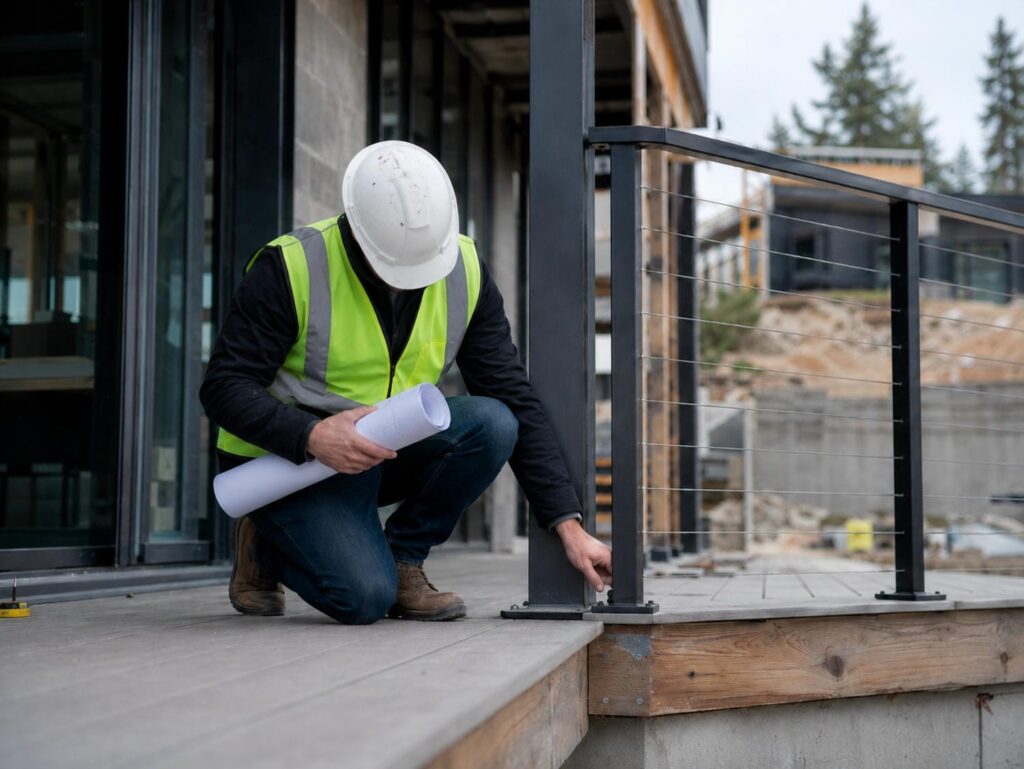
That higher number is not arbitrary. It follows from what a restaurant patio actually is in the eyes of the code. Two things push it up: the kind of place a restaurant is, and the demand that the guard be engineered rather than picked off a chart.
Assembly Occupancy Moves You Out of the Residential Playbook
A restaurant is classed as an assembly occupancy, a place where people gather. That single label changes the path your railing takes through the code. A house railing can be filled in from a residential table, with numbers a builder reads straight off the page. A restaurant guard cannot. It moves onto the structural design path, where the load has to be worked out and engineered, not looked up.
This is also where a common mix-up happens. Liquor licensing carries its own patio railing and enclosure rules, and those are about where you may serve alcohol, not how much force the guard has to hold. They are covered under the AGCO patio licensing rules for restaurants serving alcohol, and they sit alongside the load rules here rather than replacing them.
Metal and Glass Guards Must Be Engineered and Proven to the Inspector
A wood guard can follow a prescriptive wood standard, a set recipe you build to. A guard made of glass, steel, or aluminum cannot. It has to conform to the structural design part of the code, and that means a professional engineer’s stamped design. The proof of that design has to be handed to the building inspector before the railing goes in, not after.
In plain terms, a commercial aluminum or glass patio railing is not a buy-and-bolt item. You cannot order a kit, screw it to the deck, and call it done. Someone with an engineering stamp has to stand behind the design, and the city wants to see it on paper.
How a Non-Compliant Guard Becomes Your Problem
Say the railing is undersized. Say it was built to a home standard when it needed a commercial one. Who wears that? The short answer is that the exposure lands on whoever runs the patio. Here is how that works, and why insurance is not the safety net people assume.
The Duty You Owe Everyone on Your Patio
In Ontario, whoever runs the premises owes a duty to take reasonable care that the people on the patio are reasonably safe. That duty covers the condition of the place itself, not just what the staff do. It comes from Ontario’s Occupiers’ Liability Act, and the standard it sets is reasonableness, not perfection.
You are not expected to guarantee nothing ever goes wrong. But a guard that does not meet the code you were required to build to is strong evidence the patio was not reasonably safe. That is the bridge from a broken railing to a claim against you. It also answers the question owners ask most: is the installer or the restaurant on the hook? The installer may carry their own exposure for poor work. The premises duty, though, is yours, and you cannot hand it to anyone else.
Why “We Have Insurance” Is Not the Same as “We’re Covered”
Commercial general liability insurance responds to injury claims from your premises. But it responds subject to the policy’s own terms, conditions, limits, and exclusions. It is not an automatic payout, and that distinction matters more than most owners think.
Here is the honest version. Coverage answers to the wording of your own policy, and a serious injury puts the safety of your premises under a microscope. A railing that does not meet the code you were required to build to is exactly the kind of fact that can turn a claim into a fight. That does not mean a claim gets denied. It means you could be arguing about it at the worst possible time. The smart move is to confirm with your broker how your policy treats code compliance, well before anything happens.
What Compliance Costs Versus What a Failure Costs
An engineered commercial railing costs more than a residential railing kit. It has better anchors, tighter post spacing, a stamped design, and an inspection to pass. None of that is free. Weigh it, though, against what it protects you from.
The extra spend is known and one time. You pay it once, at build. A serious injury claim on a guard that failed is open ended: its size depends on the injury, the policy, and the court, and it has no ceiling you can price in advance. So any single dollar figure for a claim is illustrative, never a quote. The real answer to the cost question is plain. Building it right costs far less than one claim.
One more note for owners who already have a patio guard in the ground. Do not wait for a claim to learn whether it meets the commercial load. Have the existing guard assessed against the 0.75 kN/m standard before the patio season opens, while there is still time to reinforce or replace it.
What a Code-Compliant Patio Railing Looks Like
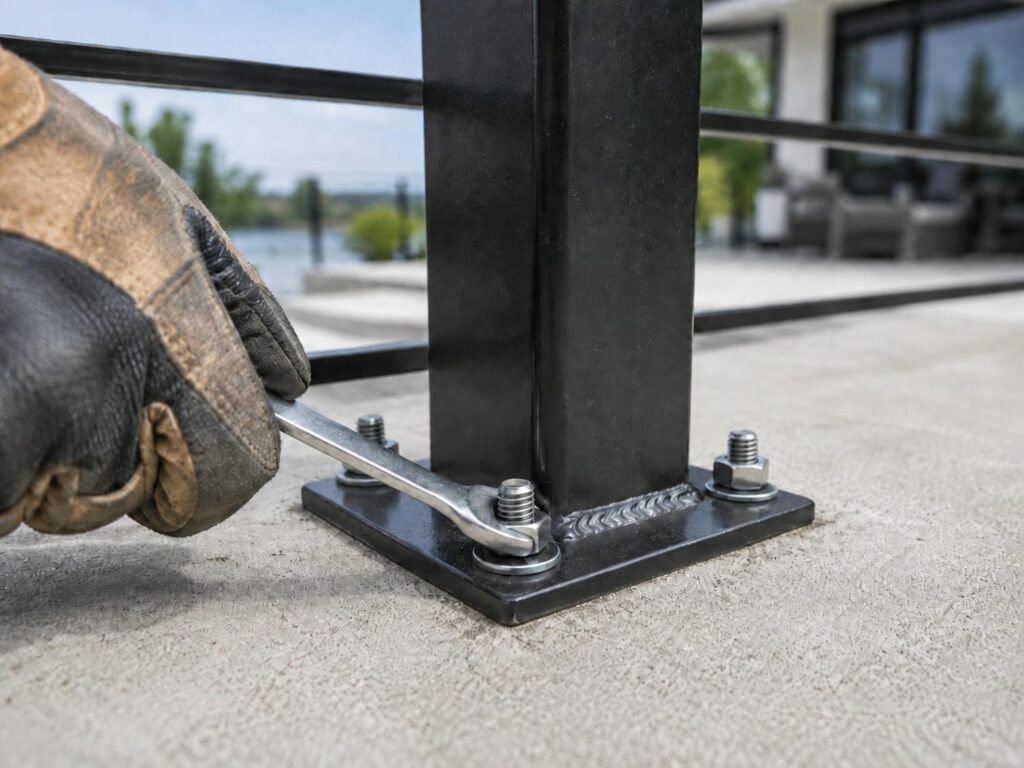
Enough about the risk. Here is what done right actually includes, so you can hold a quote up against it and see what is missing.
Engineered Design, Post Spacing, and Anchorage
The decisions that make a commercial patio guard work are mostly hidden. Post spacing is one: how far apart the posts sit changes how much force each one has to carry. The anchor detail is the other, and it is the big one: how the base transfers force out of the post and into the deck or slab. Two railings can look identical and perform nothing alike, because one has a base connection built for the load and the other does not. Anchorage is where the load path is won or lost, so it is the first thing worth asking about on any quote.
Safety Glass and Material Standards
If your patio guard uses glass, the glass itself has to be safety glass, either laminated or tempered to the recognized Canadian standard. Not just any panel that looks the part. This is a small line item that is easy to get wrong and expensive to redo, so put it on your checklist.
The same care applies to how the whole thing goes together, which is what proper guardrail installation is about: the right glass, the right posts, the right anchors, checked as one system rather than part by part.
Confirm Your Code Path Before You Build
Whether a specific patio falls under one part of the code or another, and whether an engineer’s review is triggered, depends on your occupant load and your building. No single number decides it for every patio. So the safe move is to have the guard designed and the code path confirmed by a professional before anything is fabricated. Do that, and the inspector’s sign-off becomes a formality instead of a surprise. Leave it to chance, and you can find out about a problem at the worst possible time, with the patio built and the season already here.
Build the Patio Right the First Time
You cannot fully control what happens on a busy patio. You can control whether the railing around it was built to the standard the code actually sets, and that is a decision made before the first post goes down. For over 15 years we have built railings across the GTA, certified and insured, made in Canada, built to be Ontario Building Code compliant, and backed by a 2 year warranty on materials and workmanship. If you want a guard designed and quoted to commercial load from the start, see how we approach restaurant railings and the standard we build to.
When you are ready to have your patio guard assessed, designed, or quoted, get in touch and our team will walk you through what your railing needs to meet.
Frequently Asked Questions
A commercial patio guard has to resist 0.75 kN/m pushing steadily along the top rail, or a single 1.0 kN shove at any one point, whichever is worse. On top of that it has to take a downward load of 1.5 kN/m and a localized push on any panel or picket, each checked on its own. Those loads do not all act at once, so the guard is designed for whichever governs at a given spot.
The steady push along the top rail is half again higher: 0.75 kN/m on a commercial patio versus 0.5 kN/m for a home railing. The other loads match. The bigger difference is proof: a metal or glass restaurant guard needs an engineered, inspector-approved design, while a house railing can often be built from a standard chart.
Yes. Glass, steel, and aluminum guards have to meet the structural design part of the code, which means a professional engineer’s stamped design. That proof has to be submitted to the building inspector before the railing is installed, not signed off afterward.
The operator owes a duty to keep the premises reasonably safe and carries that exposure directly. The installer may have their own liability for poor workmanship, but the premises duty cannot be handed off. A guard built below the code you were required to meet is strong evidence the patio was not reasonably safe.
Coverage answers to the wording of your own policy, including its terms, conditions, limits, and exclusions. A serious injury puts the safety of your premises under scrutiny, and a guard that did not meet the required code is exactly the kind of fact that can turn a claim into a fight. Confirm with your broker how your own policy treats code compliance rather than assuming a payout.
No. The 3.0 kN/m figure is written for grandstands, stadiums, bleachers, and arenas. A restaurant patio sits in the all other guards category, which means 0.75 kN/m along the top rail or a 1.0 kN push at any point, whichever is worse.