
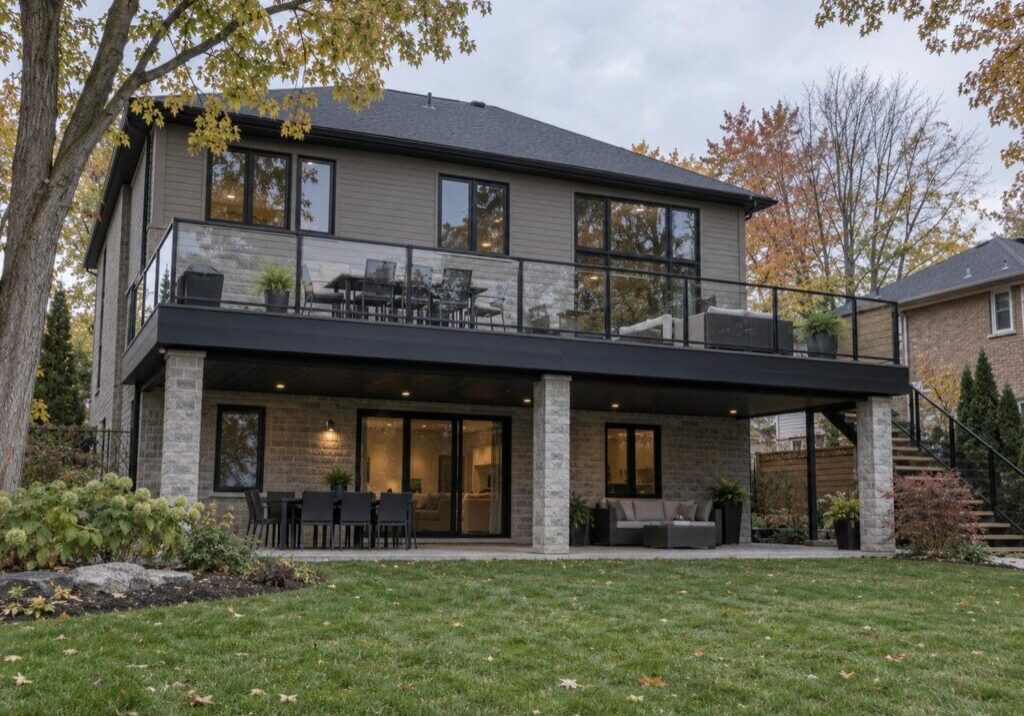
A railing that passes inspection has met a minimum on one day, against someone’s drawings. That is a real result, and it is narrower than most buyers think. Asking whether code-compliant railings are safe enough is a fair question, because every quote in front of you carries the same two words, including the cheapest one.
Our work is Ontario Building Code (OBC) compliant. Compliance is where we start, not where we stop.
Three decisions separate a railing that clears the minimum from the safest railing you could reasonably buy, and all three are made on the drawings rather than on site. They apply to custom railings inside and outside alike: what the inspection actually proves, what height to buy on an exterior guard, and what still applies to your railing after the permit closes. Miss them and you are not breaking a rule. You are simply buying less railing than you could have had for almost the same money.
What Passing Inspection Actually Proves
An inspection is one person, one day, one drawing and one set of minimums. It is also the only moment anyone is scheduled to look at your railing. When a quote says code compliant, that visit is what the phrase points at. It is a genuine check, and it answers a narrow question.
What the Inspector Checks, and What They Do Not
The check is your railing against the drawings and the published minimums. A railing that meets them passes, and that is the whole test. Nobody signs a document saying it is as safe as it could reasonably have been built, because nobody was asked to certify that. The inspector did not design your railing either. Someone else drew it, and the inspection holds the finished work up against that drawing.
Two words get mixed up constantly. A guard is the barrier that stops a fall, and a handrail is the thing your hand holds on the way down the stairs. Two components, two jobs. If what you are really pricing is a basement walkout, the baseline for a walkout basement railing sits elsewhere.
Why the Code Is a Floor and Not a Target
The rules have to work for everyone who uses them. A plans examiner needs to check them with a tape measure and a drawing, and any crew the province licenses needs to be able to build them. So they work in steps. A fall does not work in steps.
Height is only one of the things the rules set. They also put limits on the forces a guard has to resist, and the forces a commercial patio railing has to resist are written down in the same way. The size of the openings in a guard is regulated too. Every one of those limits is drawn where enforcement becomes practical. A floor is a useful thing. It is still a floor.
Check Your Figures Against the 2024 Code
The 2024 Ontario Building Code is the edition in force, and the 2012 edition is the one before it. The code was rewritten for 2025, so a figure you find in an older guide is worth checking against what your city is enforcing this year. That is a quick question to ask, and it saves an argument at the counter later. Ask your supplier which edition their details are drawn to. A fabricator who works in the GTA every week will know without looking it up.
Build Exterior Guards to 1,070 mm, Not 900 mm

This one is about the guards outside: the rail around a deck, a porch or a balcony, measured from the walking surface down to the ground. The minimum height out there is set by where the rule changes, not by where a fall turns dangerous. You are the one who chooses which side of that change to build on.
The Minimum Height Your Building Department Applies
For an exterior guard, the minimum height is 900 mm (36 inches) where the walking surface is not more than 1,800 mm (5 feet 11 inches) above finished grade. Above that, the minimum becomes 1,070 mm (42 inches). Those are the heights building departments apply, and they are the ones printed in the residential deck guide a Peterborough homeowner is handed at the counter.
Have them shown on your drawings before anything is fabricated. A height that lives only in a conversation is a height nobody can check. Suppliers will quote to whatever the drawing says, which is why the number has to be on it.
The Rules Change in a Step, and a Fall Does Not
The gap between those two minimums is 170 mm, about 6 3/4 inches. The change happens at 1,800 mm of drop. So two decks whose drops differ by 20 mm are entitled to guards whose heights differ by 170 mm.
A rule can draw that line. A body falling off a deck cannot tell which side of it the deck sits on. Both heights are minimums a building department applies, and a guard built to either one passes. One of them is simply the better buy, because you stop depending on which side of the step your deck landed on. Build the taller guard everywhere and the step stops being your problem.
The Taller Figure Is Not One a Supplier Invented
1,070 mm is not a number a supplier made up to sell you more aluminum. It is the height the same rules already apply when the fall is further.
For everything below the step, the taller guard is a choice, and it is a choice with a published number behind it rather than a brochure. If your project is well past that point, the specifications for a deck more than 6 feet off the ground are a separate conversation and worth having early.
What the Taller Guard Costs You to Ask For
At the drawing stage, the taller guard is extra post length and a little more infill. Same post spacing, same anchors, same labour to install. Next to the cost of the railing itself, it is close to free. After fabrication it is a new railing, because posts are cut to length.
So the real cost of this ask is timing, not money. A height that is wrong or missing on the drawings is what gets a railing taken off and built again at your cost. The cause of that is a drawing error, not a height choice. A guard built to the lower minimum is a legal guard, and it passes. The reason to buy the taller one is that the minimum is a floor.
Buy a Railing Whose Anchors Have Been Tested
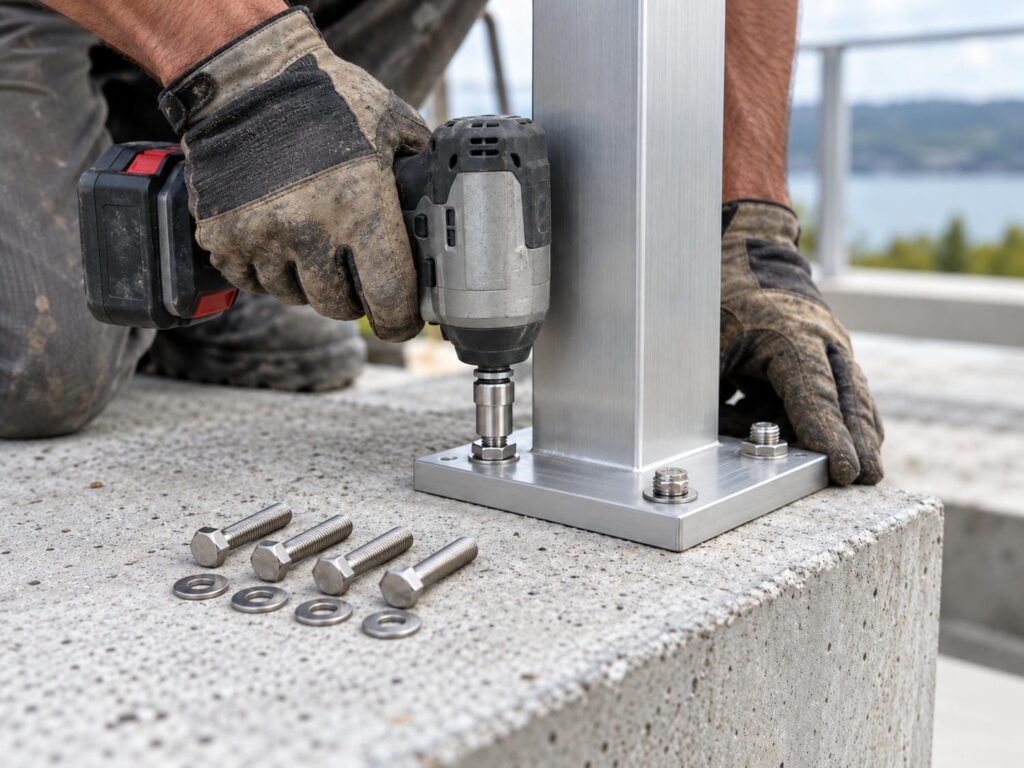
Pick a railing system the rules have not already drawn, and what your building department asks for is a document. A document is not the same assurance as a test. That holds whether the railing goes on a deck or up an open staircase inside. It is the ask most buyers never make, and the one that separates two identical-looking quotes.
What Your Building Department Asks For Is Paperwork, Not a Test
Ontario’s Building Code carries a supplementary standard for guards in housing and small buildings, SB-7. It sits in Volume 2 of the 2024 code, and it draws guard connection details. If the guard you pick is not one the standard already draws a detail for, your building department wants the manufacturer’s installation instructions, or drawings stamped and signed by an engineer licensed in Ontario. Building departments across our service area draw that line in the same place.
Guelph puts it plainly in its own submission requirements: for a guard that is not wood, send the manufacturer’s name and the engineering documentation. That paperwork is part of what you are buying. A quote that never mentions it is a quote planning to sort it out after your deposit.
What a Tested System Actually Means
There are published test methods for exactly the things the Ontario floor does not pre-draw. ASTM E894-23 is the test for the anchorage: how much tension, shear and twisting the connection into concrete, masonry, wood or metal will take. Those results are what a designer uses to size a connection for a real post on a real wall.
ASTM E935-21 is the other one, and it tests the whole assembly as it is installed and fastened. One checks the connection. The other checks the railing that connection is holding. Neither test is a requirement, and that is the point. A supplier who has run them can hand you the report, and a supplier who has not will tell you the system is code compliant instead.
The Anchors Are the Part You Cannot See
Everything that happens to a railing ends up in the same place. A crowd leaning, a child swinging, a chair pushed back against it: all of it becomes a bending force and a prying force at the base of the post. The connection into the structure is the real failure point. It is also the part nobody can look at once the fascia is on.
Most budgets go the other way, into the infill, because the infill is the part you can see. We are certified and insured, and we stand behind the connection as much as the rail on top of it. Our railings are made in Canada, which means the brackets, posts and fasteners come from a supply chain we can ask questions of.
What to Ask a Supplier, and What It Costs
Three questions sort a quote out, and they go in this order. Ask for the test report for the anchorage. Ask for the test report for the assembly. Ask for the stamped drawing where the system is not one the supplementary standard already draws.
A system that arrives with none of this is usually cheaper, and the reason matters. It is cheaper because the evidence was never produced, not because the railing is simpler. Somebody paid for the testing on the systems that have it, and that cost is in the price. You are choosing between a railing with a history and a railing with a price.
In Toronto, the Rules Do Not Stop at the Inspection
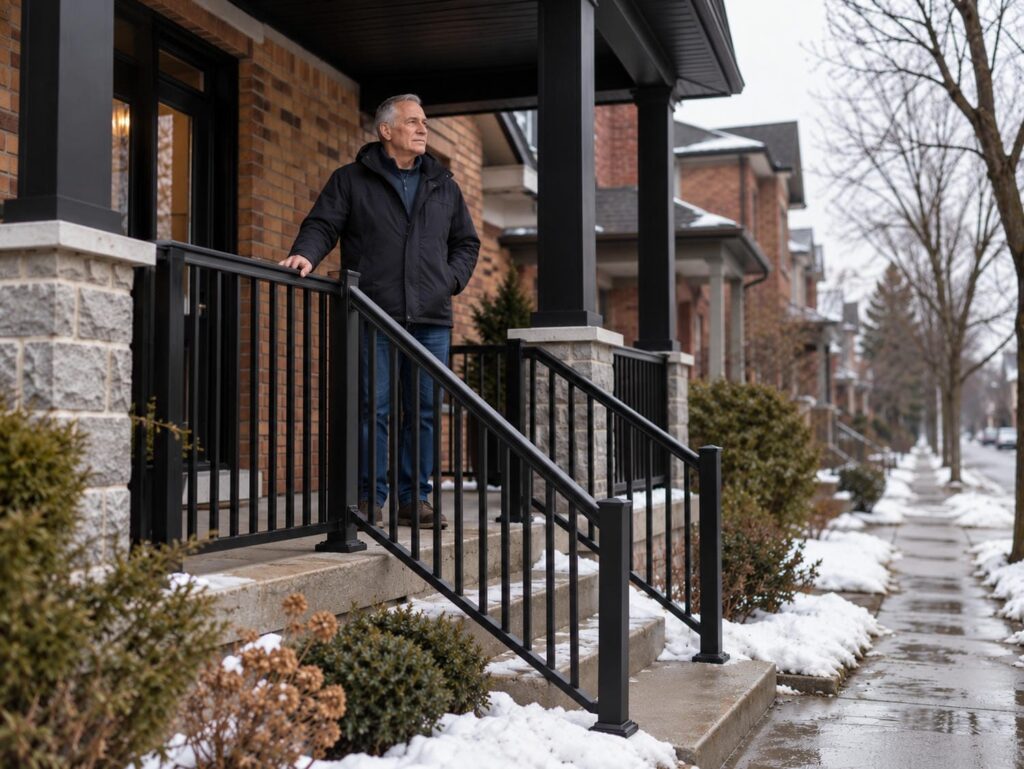
The permit inspection is the last scheduled look anyone takes at your railing. In Toronto, the duty to keep it in good repair starts the day that inspection ends, and it never expires. The Toronto wording covers stairs, porches, decks, balconies, guards and handrails together, so an interior stair sits under it as readily as a back deck.
What the Permit Inspection Covers, and When It Ends
A permit inspection is a build-day test. It happens once, against the drawings, and then it is finished. Nothing in it follows the railing into the years afterwards. No one comes back to see whether the fasteners are still tight or whether the finish held.
That is not a criticism of the inspection. It is a description of what the inspection is for. A build-day test proves the railing was built right. Whether it is still right is a question somebody else asks, under a different set of rules, and usually much later.
Toronto Requires Guards to Be Kept in Good Repair
In Toronto, stairs, porches, decks, balconies and similar structures, along with their guards, handrails and supports, have to be kept in a safe condition and in good repair. No end date is attached to that. It applies to the railing you installed last spring and to the one that went in before you bought the house.
Enforcement starts with a resident contacting 311. Officers review the complaint and may investigate. An owner who does not comply can receive an order to comply or a notice of violation. Property standards wording and permit triggers both differ between municipalities, so if you are outside Toronto, ask your own city how it words this.
What Actually Brings the City Back to Your Railing
Two things bring the city back to a railing. A complaint is one. The other is a permit, and a permit is something you apply for. In Guelph, a permit is required to replace the guards on an existing deck or porch. Oshawa writes its trigger as a deck more than 24 inches above the ground, or one that carries a roof, and that is the city’s own wording.
No one hands you a date your railing expires. What you get instead is an obligation, and it does not come with a reminder. So look at the railing yourself each spring, because how to look after a railing season to season is the one part of this nobody schedules for you.
What to Specify So the Railing Survives Ontario Winters
Ask for a railing whose fasteners and finish are built for fifteen winters. Then make the answer specific. A named product or a written specification on the quote can be checked later. “Premium hardware” and “marine grade” with nothing after them cannot.
Ask who warrants which part. The fastener and the finish usually come from different makers, so they are rarely warranted by the same party. Our own commitment is 2 years warranty on all materials and workmanship, in writing. Expect any supplier to tell you where their coverage starts and stops.
A railing gives up at the base of the post first, not at the infill. Keep the quote, the specification sheet and the stamped drawing. An obligation with no end date outlives everyone’s memory, and a repair years from now has to be made against something.
From Code-Compliant Railings to Safe Enough: What to Put in Your Quote
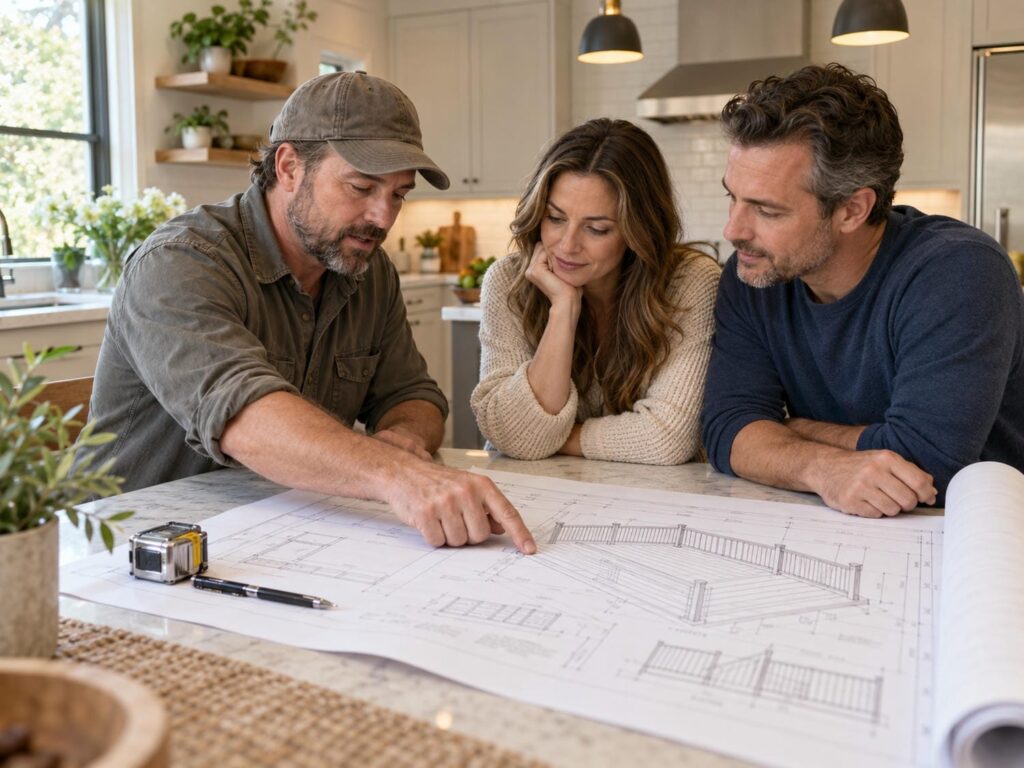
All three asks are drawing-stage decisions. That is what makes them cheap today and expensive once the posts are cut. Put them in front of whoever is quoting the job, then ask to see them on the drawing and in the written quote before you sign anything. A supplier who agrees on the phone and writes nothing down has agreed to nothing.
| The decision | The code minimum | The better specification | What to ask for |
| Exterior guard height | 900 mm (36 inches) until the walking surface is more than 1,800 mm (5 feet 11 inches) above finished grade | 1,070 mm (42 inches) throughout | “Show 1,070 mm guard height on the drawings” |
| Proof | A drawn connection detail, the manufacturer’s instructions, or an Ontario engineer’s stamp | Anchorage and assembly tested to a published method | “Send the test report for the anchors and the assembly” |
| After the inspection | A single inspection at the permit stage | Fasteners and finish specified for Ontario winters, in writing | “Put the fastener spec, the finish, and the warranty in the quote” |
Where Each Ask Belongs: Drawings, Quote, and Warranty
The height goes on the drawings. That is the document the inspection is run against, and the one the fabricator cuts from. The test reports and the stamp belong in the submission package and in the written quote, because that is what the building department asks to see and what you keep afterwards. The fastener specification, the finish and the warranty belong in the quote itself, because nothing after installation will record them for you.
Each ask has a home, and an ask in the wrong place is an ask nobody can act on. A supplier who cannot put these in writing is not necessarily selling a bad railing. They are selling one you cannot check.
Work With a Railing Builder Who Specifies Above the Minimum
You now have three asks that fit on one page of a quote: the guard height on the drawings, the test reports or the stamp in the submission, and the fastener and finish specification in writing. Put them in front of whoever is quoting, and watch what comes back. The answers tell you a lot about who you are dealing with.
GTA Railings has been building exterior & interior railings for over 15 years across the Greater Toronto Area, and we carry 2 years warranty on all materials and workmanship. We show the guard height on the drawings before anything is cut, provide the documentation your building department asks for, and put the fastener and finish specification in the quote.
If you have drawings in hand or a quote you are not sure about, book a consultation and we will go through it with you.
Frequently Asked Questions
Code compliant means the railing met the published minimums on one day, measured against the drawings, and a railing that meets them passes. It does not mean anyone certified it as the safest railing you could have bought. Three asks close that gap: show the guard height on the drawings, get the test reports for the anchorage and the assembly or the engineer’s stamp, and have the fastener and finish specification written into the quote.
Yes, and on an exterior guard it is usually the better buy. The minimum height rises once the drop gets big enough, so a taller guard everywhere means that change never costs you a decision. Ask for it while the drawings are still open, because the posts are made to the height on the drawing. Once they have been cut, raising the guard means ordering the railing again.
Three things. The test reports for the anchorage and for the assembly, or a drawing stamped and signed by an engineer licensed in Ontario where the system is not one the supplementary standard already draws. The fastener and finish specification, named as products or specifications rather than described with adjectives. And the warranty, with a clear statement of which party stands behind the fasteners and which stands behind the finish.
SB-7 is Ontario’s supplementary standard for guards in housing and small buildings, published in Volume 2 of the 2024 Ontario Building Code. What it holds is drawings: worked-out guard connection details a builder can follow. A railing the standard does not already draw has to prove its connection some other way, and that proof is documentation you should see before you pay for the railing.
Your building department does, and it decides through what it asks for in the drawing submission. Where the guard is not one the province’s supplementary standard already draws a detail for, the submission carries the manufacturer’s documentation or drawings stamped and signed by an engineer licensed in Ontario. That line sits in the same place across our service area, so settle the question before the drawings are finished rather than after the railing is ordered.
In Toronto, yes. Guards, handrails and the structures they sit on have to be kept in a safe condition and in good repair, and that obligation has no end date. Nothing schedules another look at your railing. A complaint to 311 can still bring one, and officers review complaints and may investigate. Outside Toronto, property standards wording differs between municipalities, so ask your own city how it words the duty.