
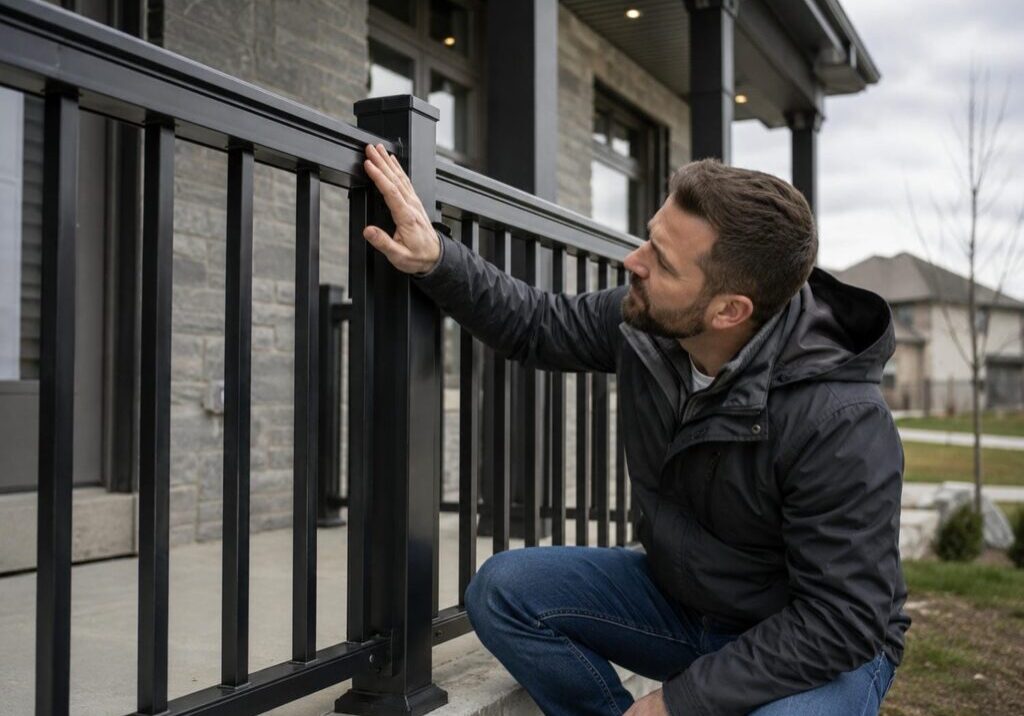
Aluminum contains no iron, so it will never rust. That single fact is why so many railings get written off years too late: the owner is watching for orange, and orange is not the signal this metal sends. What fails first is the finish. On aluminum railings, the metal carries the load and the baked-on coating carries the colour and the weather, and the coating is the part with a service life.
By the time anything on the surface looks like corrosion, the finish has usually been giving up for years. The good news is that it announces itself. There are four aluminum powder coating failure signs you can find yourself, in daylight, with nothing but a dark cloth and a fingernail, and each one tells you something different about how much time you have left.
Why Waiting For Rust Is The Wrong Test On An Aluminum Railing
Rust is a corrosion product of iron and steel. Aluminum is not an iron alloy, so it has no iron to give up, and it will never produce orange scale no matter how long it sits in a Toronto winter. That does not make it immortal. It makes the failure look like something else.
What actually fails is the thin baked polymer film sprayed onto the metal at the factory. That film does two jobs and only two: it supplies the colour, and it stands between the metal and the weather. How powder coating compares with anodizing matters when you are choosing a finish, because one sits on the metal and the other is grown into it.
The film gives up in a predictable order. It loses gloss, then the colour shifts and goes uneven face by face, then the surface chalks, then it loses its grip at the edges, welds and drilled holes, and only after all of that does the metal itself come under attack. Everything before the last stage is visible or touchable without a single tool.
Sign 1: Chalking, Fading And A Finish That Has Gone Flat
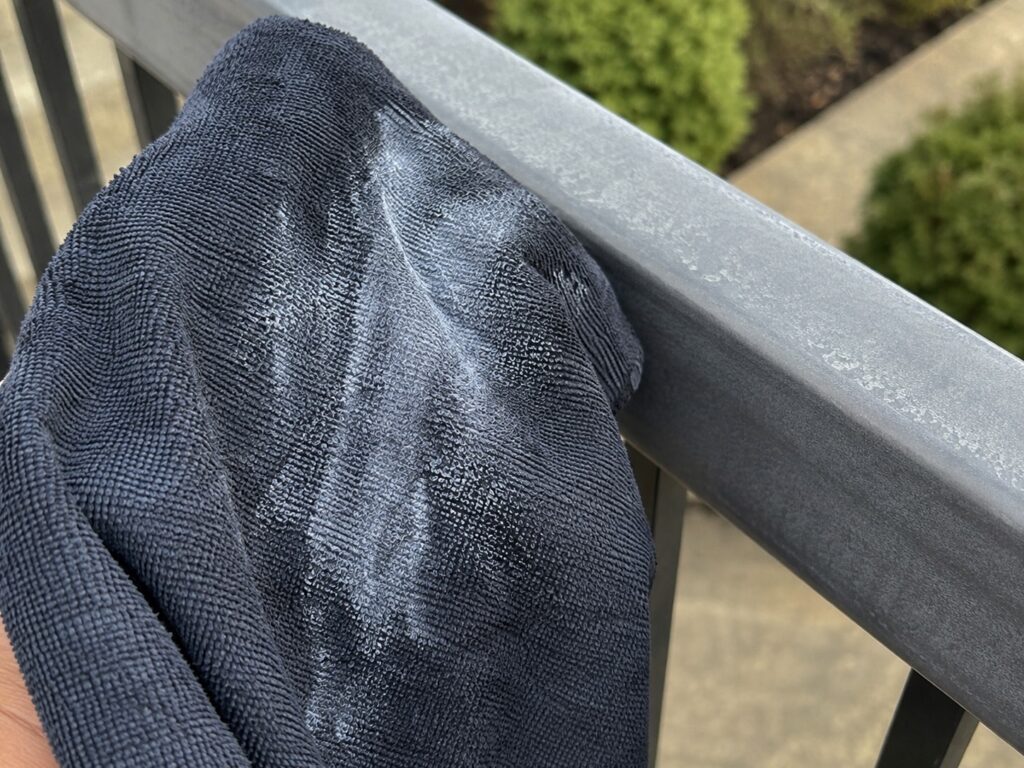
Chalking is the first thing a powder coated finish does when it starts to go, and it is the only sign here you can confirm in two minutes with something already in the house. You need a dark rag and daylight, not a specialist.
The Two Minute Test With A Dark Cloth
Wipe a length of the top rail with a dark cloth or the back of your hand. If a fine powdery residue transfers, that is chalk. Chalk is the coating leaving, not dirt arriving, which is why it wipes off cleanly and comes back a month later. The professionals who grade this failure do the same thing you just did: they transfer the deposit onto fabric and compare it against reference photographs.
Then use your eyes. Compare a sun-facing face of the railing with a shaded face on the same run. The colour may no longer match, and fade is judged against a reference rather than against your memory of the day it was installed.
Why A Chalky Finish Is Protecting Less, Not Just Looking Worse
UV light and moisture work on the coating together. They attack the chemical bonds in the resin and the pigment, and the barrier property degrades along with the colour. So the dullness is not a separate cosmetic issue sitting on top of a healthy finish. It is the visible edge of a film that is thinning chemically.
That turns a complaint about looks into a warning about protection. Gloss is measured with an instrument, not judged by mood, so “it has gone flat” is a real observation and not a matter of taste. A flat, chalky railing is doing less of the one job it was put there to do.
How Fast A Standard Finish Goes Flat, And Why Your Railing May Differ
Standard grade exterior coatings show visible degradation inside about 18 to 24 months of benchmark exposure, losing half their gloss or more after 2 years, and rich, dark colours show it first. The industry measures weathering in coastal south Florida because that is the standard exposure location in North America. Toronto is gentler on UV and harsher on salt and freeze-thaw, so those numbers tell you how a finish ranks, not how many winters your railing has left.
Which way the railing faces, how close it sits to a salted walkway, and which powder was used decide it here.
Sign 2: Blisters And Bumps Under A Finish That Still Looks Intact
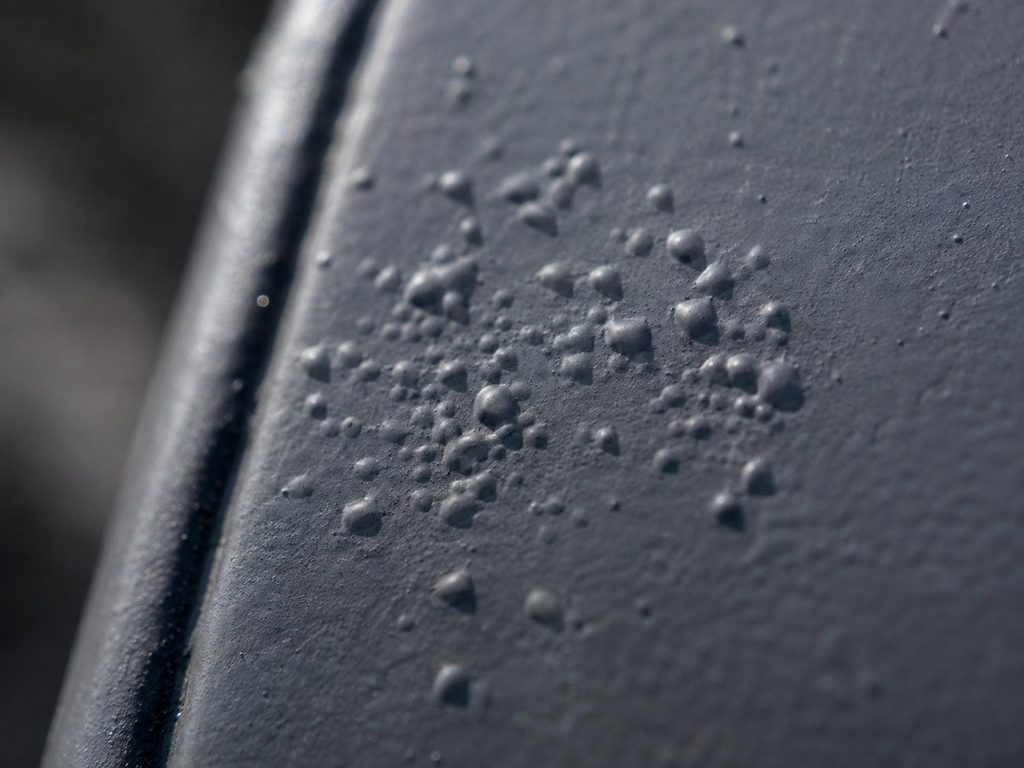
A blistered railing usually looks fine from the driveway. The film is unbroken and nothing is flaking. Get close and run your hand along it, and you find bumps. Something under the coating is pushing out.
What Blistering Looks Like On A Railing
Look for raised bumps or small bubbles in a finish that is otherwise sound. They usually come in clusters rather than scattered singles, and very often one section of railing is covered in them while the identical section beside it is completely clean.
That patchiness is the observation worth having. It points at something under the film in that spot rather than at the whole railing changing at once. Blistering is a defined coating failure, graded by how big the blisters are and how densely they sit. It is a condition with a name and a scale behind it.
How A Blister Gets Under An Unbroken Finish
A blister means something under the film is pushing it up. Contamination or moisture left on the metal before the powder went on can stay trapped there and expand, lifting the coating from underneath, and that can show up long after the railing was installed. Blistering from that cause tends to appear in patches, on one section and not on the identical section beside it, rather than evenly across the whole railing.
The detail that makes this vivid is the oven. Powder is cured with heat, and as the temperature climbs, anything trapped between the coating and the metal expands with it. That is the moment the film gets lifted, well before anybody sees a bump.
Why Touching Up A Blister Rarely Holds
The instinct is to sand the bump flat and dab paint over it. That seals the symptom and buys you a season, because whatever is trapped underneath is still trapped underneath, still expanding, still lifting whatever you put on top.
A real repair goes the other way. It gets back to clean metal in that area, works out how far the affected zone actually runs, which is almost always further than the visible bumps, and then rebuilds the finish over properly prepared metal. In practice that means a blistered section is usually stripped and recoated rather than spot repaired. Paying to do it once is cheaper than paying to do it three times.
Sign 3: Flaking And Peeling At Edges, Welds, Holes And Fasteners
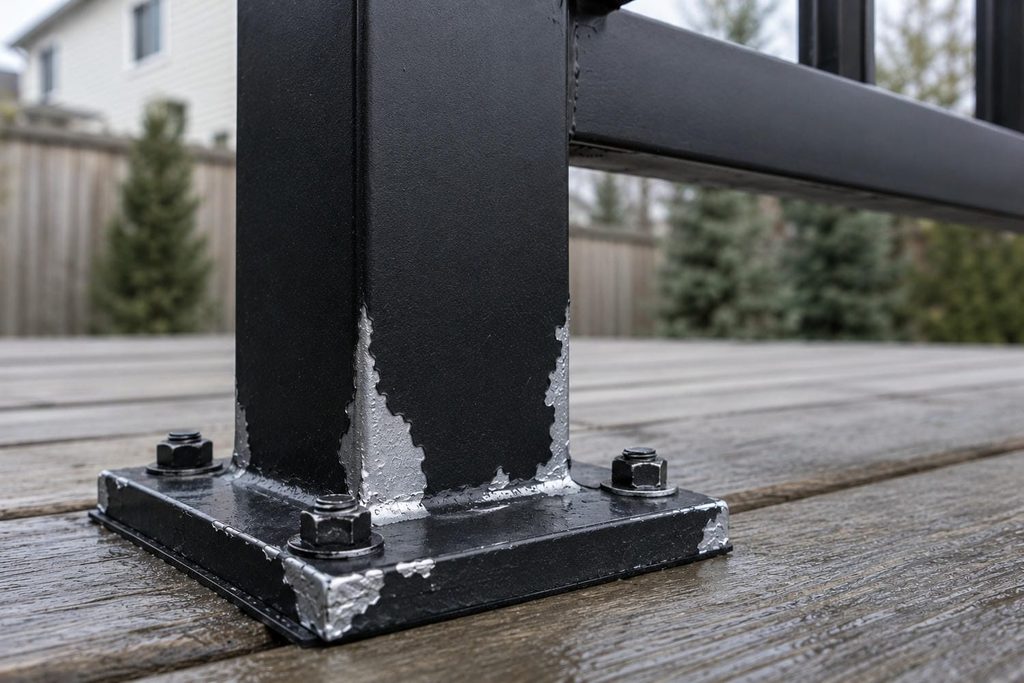
This one is about location as much as appearance. A coating almost never lets go in the middle of a flat face first. It lets go where it was thinnest, where it was disturbed, or where it never bonded properly.
Where To Look First On Your Railing
Start at the cut ends and the mitred corners. Then the weld areas. Then the drilled holes where pickets land, and everywhere a fastener passes through the finish, including base plates and wall brackets. Finish with the sharp edges and corners on the top rail.
Powder pulls thinner over a sharp edge than over a flat face, so the barrier is already at its weakest there before the railing leaves the shop. Every secondary operation, a cut, a weld, a drilled hole, is somewhere the finish is thinner, applied later, or absent. Run a fingernail along those areas. You will feel a lifted edge before you can see one from 2 metres away.
What Makes A Coating Let Go
Three causes account for most of it. Under-cured powder shows poor adhesion, and heavy sections are the usual offenders because thick metal can be slow to reach temperature all the way through. Contamination picked up after cleaning and before coating is the second: the metal collects whatever is in the air while it waits to be sprayed. The third is powder sprayed over an existing coating nobody identified, which can let go from that older layer instead of bonding through it.
Nothing good happens to a part once it has been cleaned, which is why it gets coated right away. Where the finish has lost its grip it flakes and peels, and it starts at a cut end, a weld, a picket hole or a fixing rather than in the middle of a flat face.
How A Finisher Confirms Adhesion Loss
Adhesion is not a matter of opinion either. A finisher checks it with a tape test: a set of cuts is made in the film, tape is pressed over the cuts and pulled off, and how much coating comes away with it is graded on a fixed scale from 0 to 5.
That matters for one reason. “The paint is peeling” is an argument. A graded result is a record. If a conversation with whoever supplied or finished the railing is coming, ask for the test and ask for the number.
Sign 4: Fine Thread-Like Lines Creeping Under The Coating

This is the sign almost nobody knows to look for, and it is the one that means the clock is nearly out. It hides in plain sight: the finish still looks whole, the colour is still there, and nothing on the railing is orange.
What Filiform Corrosion Looks Like
Filiform corrosion shows up as hairline threads or worm-track lines spreading underneath the coating. From a step away the finish looks sound. Up close you see fine, wandering filaments that radiate outward from one starting point: a scratch, a cut edge, a drilled hole, or a chip taken out by a snow shovel.
Nothing is flaking yet. Nothing is orange. The surface may still be glossy where the tracks run, which is why this gets missed. Look along the finish rather than at it. Crouch down and view the rail sideways in low sun, and the tracks lift out of the surface as shadow lines you cannot see from straight on.
Why It Only Takes A Scratch And Damp Air
The mechanism is simple. Coatings on metal develop this pattern when two conditions are met at once, and the industry test guide for this failure mode names them: a break in the film, and relative humidity in the 70 to 95 percent range.
Filiform corrosion needs two things, a break in the film and damp air. This region supplies the damp air every year, so once the film is broken the clock is running.
On an aluminum railing a scratch is not cosmetic damage. It is a starting point, and a chip left alone at a picket hole is not a blemish you have decided to live with. It is an entry.
Why This One Is Aluminum’s Characteristic Failure
Coatings on metal in general can develop this pattern. On aluminum alloys it is the dominant form of under-paint corrosion. That is what makes it the failure mode to know about on this metal, and it is exactly why a homeowner scanning for orange rust walks straight past it.
The film is still on. Underneath it, the metal is already being worked on from the edge inward, and the threads are the map of how far it has got. This is the last stage before the metal itself is under attack.
Aluminum Powder Coating Failure Signs At A Glance
The four signs show up roughly in this order, but a railing rarely shows them one at a time. A rail that is chalking on its south face is often lifting at a picket hole on the same run. When two signs are present together, it is the more advanced one that sets your timeline, not the milder one.
| Sign | What You See Or Feel | What Is Behind It | How Urgent It Is |
| Chalking, fading and gloss loss | Powdery residue on a dark cloth, a flat finish, and a sun-facing face that may no longer match the shaded side | UV and moisture breaking down the resin and pigment, which thins the barrier as well as the colour | Act this season. At this stage it is usually a clean and a recoat |
| Blistering | Raised bumps or bubbles under a finish that is otherwise unbroken, usually in patches on one section and not the next | Contamination or moisture that can stay trapped under the film, then expand and lift the coating from underneath | Get it assessed. A touch-up over the bump will not hold, because the cause is underneath |
| Loss of adhesion | Finish flaking or peeling at cut ends, welds, picket holes and around fasteners | Under-cure, contamination after cleaning, or powder applied over an unidentified existing coating | Prompt. The film is open and water is reaching bare metal at the weakest points |
| Filiform corrosion | Hairline thread or worm-track lines creeping under a sound-looking film from a scratch, edge or drilled hole | A break in the film plus damp air. It is the dominant under-coating corrosion on aluminum | Urgent. This is the last stage before the metal itself is attacked |
What Actually Shows Up When Aluminum Does Corrode
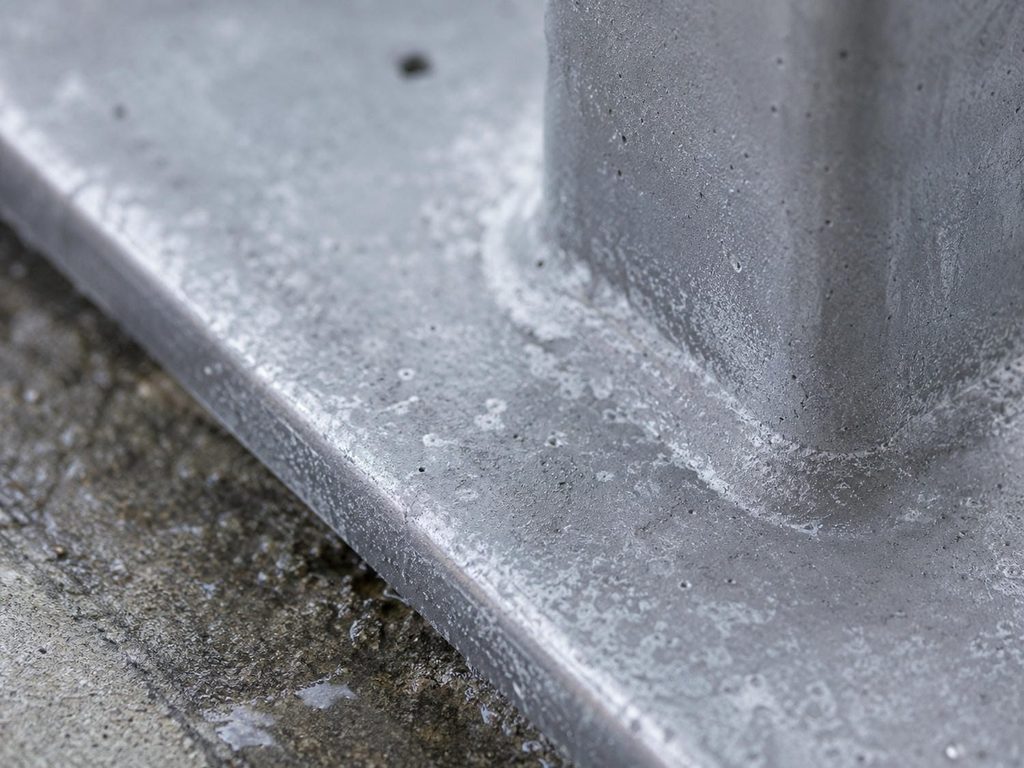
You have been watching for the wrong colour. Aluminum does corrode, and when it does it produces nothing that resembles rust. Knowing what it actually produces is what separates a finish problem from a metal problem.
Dull Grey, White Powder And Small Pits
Corroding aluminum goes dull grey, or it grows a white, powdery oxide on the surface. The most common form it takes is pitting: small, localized holes rather than sheets of scale. On a railing that usually looks like a patch of chalky white bloom with tiny craters under it, often near a base plate where water sits.
Aluminum protects itself with a thin oxide skin, and chloride makes that skin unstable so it breaks down in spots. Those spots are where the pits start. Every one of the four signs is a warning that the barrier standing between chloride and that oxide skin is thinning, opening, or already open. The metal is still the right choice, and why aluminum holds up better than other railing materials has not changed. The finish is the part with a service life.
If You See Orange Staining, Look At What Is Holding The Railing Together
Orange staining on an aluminum railing is a different question. Aluminum does not produce that colour. Steel fasteners, steel anchors, or steel dust from grinding done nearby usually do.
There is a general principle behind it. Put two different metals in contact and add water, and one of them corrodes faster than it would on its own. That is why fastener choice at an aluminum railing is not a detail. Trace the stain upward to where it starts and look at what is directly above it. Usually it is a bolt.
Why Greater Toronto Winters Move This Along Faster
The same railing ages at two different speeds depending on where it stands. Our winters put two pressures on a finish that a milder climate does not, and both of them work on a finish that is already open.
What Road Salt Does Once The Finish Is Broken
Start with the scale. The City of Toronto typically uses between 130,000 and 150,000 tonnes of road salt on winter road maintenance each year.
Salt spray, slush thrown from the road, and salt tracked onto a porch on boots all put chloride against the finish, and chloride is precisely what destabilizes aluminum’s protective oxide wherever the film is already open. An intact finish is the barrier that keeps chloride off the metal. Salt is not what puts the first break in a coating. It is what makes that break expensive.
Salt left sitting keeps a wet, ion-rich film pressed against the coating for months, which is why a spring rinse is the cheapest maintenance you can do.
Freeze And Thaw Works On Every Break In The Finish
Our winters cycle above and below freezing dozens of times a season. Every cycle drives moisture into any break in the finish and then expands it as it freezes. A hairline chip does not stay a hairline chip through that.
This is the practical reason a small mark matters here more than it would somewhere with one long, stable cold season. A chip at a picket hole in November has been wetted, frozen and forced open repeatedly by the time the snow goes, and the same chip is a track running under the coating by May. The season does the work.
Where Your Railing Sits Changes How Long The Finish Lasts
A south-facing balcony rail takes UV all day. A porch rail beside a salted municipal sidewalk takes chloride splash all winter. A pool rail takes chlorinated water. A sheltered north-facing stair rail takes almost nothing. Same railing, same coating, same installer, four different service lives.
The sheltered north-facing run and the south-facing porch rail beside a salted walk are not doing the same job and will not age the same way. Expect the exposed one to be chalking and lifting at its edges while the sheltered one still looks close to new. Expect to be inspecting the exposed one every spring while the sheltered one goes years between real looks. Expect the exposed one to reach a recoat well ahead of its twin.
Inspect your worst-exposed run first, and judge the whole railing by that section rather than by the one you see from the front door.
What To Do About It, Stage By Stage
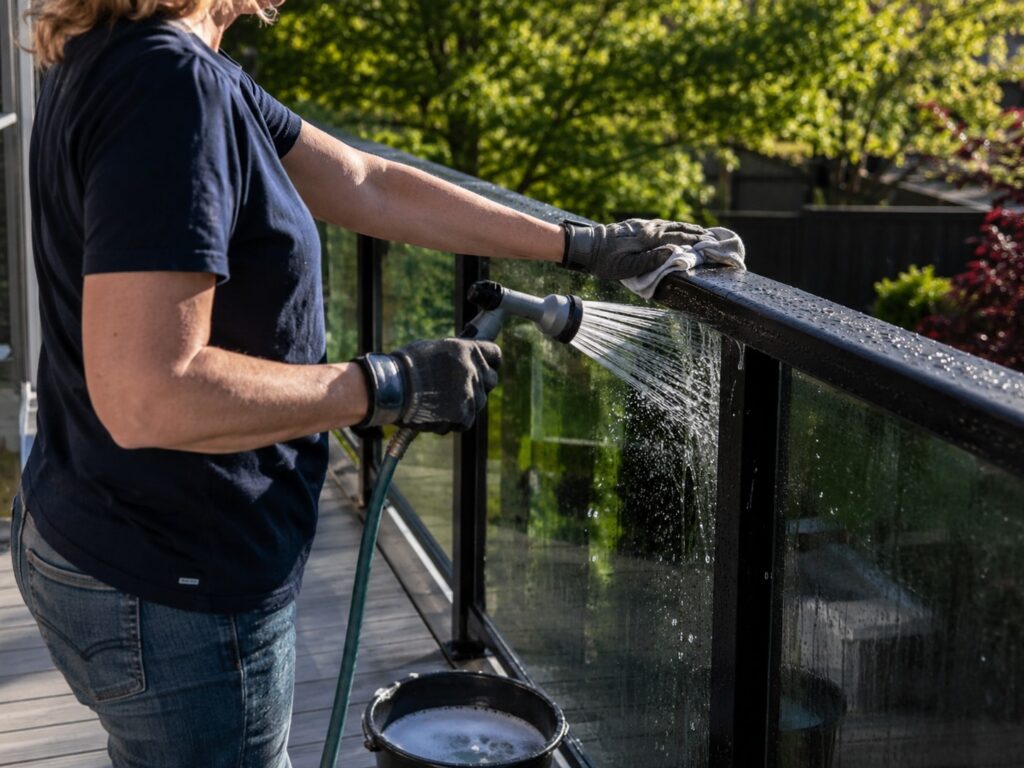
What the railing needs depends on which sign it is showing, and the cheapest response is always the earliest. Some of it is a Saturday with a hose. Some of it needs a shop.
Rinse It Before You Do Anything Else
Rinse the salt off in spring, before it sits through a wet summer. Use water and a mild soap, never an abrasive, and never a pressure washer on a finish that is already chalking, because both strip a compromised film faster than the weather does.
Finished architectural aluminum needs washing to hold its finish, and hand rails are no exception. That is a recognized industry requirement for finished aluminum, not a contractor’s suggestion.
Rinsing is the step that gets skipped. It is one part of routine railing maintenance, which also covers the hardware and the fixings.
When A Clean And Recoat Is Enough, And When It Is Not
Catching this at the chalking stage usually means a clean and a recoat. Catching it after the coating has lifted and the metal is pitting usually means replacing the affected sections. The gap between those two outcomes is the reason to look now.
Between them sit the middle cases. Blistering confined to one section is repairable. Adhesion loss at a handful of picket holes is repairable. A run of fine tracks from one deep scratch is repairable. Widespread pitting with adhesion loss across several sections is not, and knowing when an exterior railing is past repair saves paying twice.
Going Back To The Company That Finished It
Some of what you are looking at can trace back to before the railing ever arrived. That is worth a calm conversation, not an accusation. Bring a file, not a complaint.
Put the record together first. The original quote or invoice with its date. Photographs of each affected section, and a photograph of a matching section that is clean, because the pattern is part of what a finisher will want to see. Add your own record of rinsing and cleaning, since a finish claim can turn on how the railing has been looked after.
Then ask three things. What the finish was specified to. What the warranty covers and what conditions it carries. And ask for the tape test, so the coating’s condition is a graded result rather than an argument.
If the railing is outside its warranty, or the finisher has closed, the decision is simply recoat what is worth saving and replace what is not.
What To Ask Before Anyone Recoats It
Before anyone quotes you for a recoat, ask five questions. Whether anyone has identified what is currently on the metal, because coating over an unknown film is one way this fails. What pretreatment will be used, and where the work happens. Whether the parts will be stripped or only scuffed. What is being done differently at the edges, welds and holes where the last finish gave up. And what of it goes in writing.
Any shop worth using will answer all five in the same conversation. A shop that gets vague about pretreatment is telling you something.
How To Avoid Buying This Problem Again
A lot of what decides whether a finish lasts is settled before the railing is ever delivered, and none of it is visible on the finished product. Two railings can look identical on the day they go in and be years apart in how they age.
Powder Coated Is A Process, Not A Performance Level
“Powder coated” names a process, not a performance level. It does not tell you which finishing specification the coating had to meet, or how much colour and gloss the finish was required to hold on to after years outdoors. Two quotes can both say “powder coated” and describe completely different products.
So ask your supplier which specification yours was coated to, and get the answer in writing. The three architectural specifications are AAMA 2603, 2604 and 2605. They run from pigmented, through high performance, to superior performing, and each step up sets harder targets for how much colour, gloss and chalk resistance the finish must keep after years outdoors.
Here is the catch. A supplier quoting salt spray hours is quoting a controlled comparison test. Performance in real outdoor conditions has seldom been shown to correlate with those results on their own. Salt spray hours rank finishes. They do not promise years on a Toronto porch.
Ask What Happens At The Welds, Edges And Drilled Holes
The places a finish fails are also the places to ask about before you buy. Ask what happens to a cut end after fabrication. Ask whether the picket holes are drilled before the powder goes on or punched through the finish afterward. Ask how welds are prepared. Ask whether the fasteners are compatible with aluminum, because mixing metals at a fixing is how a good finish gets a stain running down it.
A supplier who has an immediate answer to those four has thought about the finish. One who only talks about colour has not.
Read The Finish Warranty Before You Need It
Finish warranties are not maintenance-free promises. They come with conditions, and salt exposure and neglected cleaning are the two that most often take a claim off the table. Read yours before you need it.
Warranty periods in this industry are tiered by finish type, so what is covered on one product is not what is covered on another, and a term on its own means very little. A long warranty with tight conditions can be worth less than a shorter one with sensible ones.
Get A Straight Answer About Your Railing’s Finish
The next question is harder than spotting the sign: is this railing worth recoating, or is it time to replace sections of it? That is a judgment call, and it needs someone with hands on the actual metal, looking at the exposure, the welds and the fasteners.
GTA Railings has been building railings across the Greater Toronto Area for over 15 years, our railings are made in Canada, and everything we supply carries a 2 year warranty on materials and workmanship. Our custom aluminum railings are specified with the finish in mind from the start.
Send us photographs of the sections that worry you, or book a look at your railing and we will tell you plainly which of the four you are dealing with.
Frequently Asked Questions
No. Rust is what iron and iron-based metals produce, and aluminum contains no iron to give up. Aluminum does corrode, but it looks nothing like rust. It goes dull grey, grows a white powdery deposit, and develops small pits rather than orange scale. If you are waiting for orange before you act, you will be waiting a long time while the finish does all the failing.
No. Dirt arrives; chalk leaves. If a dark cloth comes away with a fine powder, wipes clean easily, and picks up more powder a month later, that is the coating breaking down at the surface rather than soil settling on it. Dirt washes off and stays off until something puts it back. Chalk keeps coming, because the film keeps giving it up.
A blister means something under the film in that spot is pushing it up, which is a local condition rather than something happening to the whole railing at once. That is why blistering tends to show in patches: one section blistered while the identical section beside it stays clean. That pattern is part of what a finisher will want to see, so photograph both.
It will make it worse. A pressure washer drives water into every break in the finish and strips a compromised film faster than the weather does, and abrasive cleaners do the same thing more slowly. Water, a mild soap and a soft cloth are the right tools on a finish that is already chalking. Save the pressure washer for the driveway.
Sometimes, and it depends on which sign the railing is showing. Chalking and light fade are usually a clean and a recoat. Widespread adhesion loss and pitting usually mean replacing the affected sections instead. Site conditions matter too, because proper preparation is hard to achieve on an installed railing, so a shop recoat often produces the better result.
It attacks the aluminum wherever the finish is already broken. Chloride destabilizes the thin oxide layer aluminum uses to protect itself, and that is where pitting starts. An intact coating is the barrier that keeps salt off the metal in the first place, which is why a broken finish beside a salted walkway is the combination that does the damage.
Answer it by exposure rather than by a number of years. Which way the railing faces, how close it sits to a salted walkway, and which powder was specified are the three things that decide it. Change any one of them and the answer changes with it, which is why a single figure for the region would be worth nothing to you.