
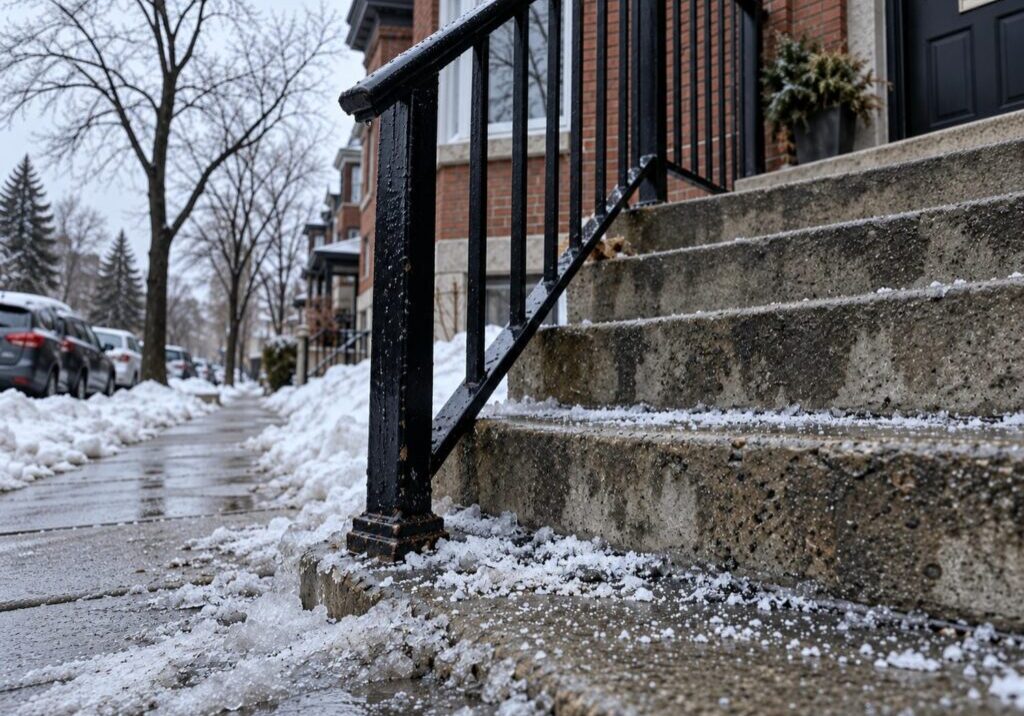
Toronto winter salt is why iron railings here rust years earlier than the same railings would in a drier city. Five years is about how long it takes for salt damage to become something you can see on a painted steel railing in Toronto. It is not how long it takes for the railing to stop being safe. Those are two different clocks, and the one that costs money is the slower one.
We build custom railings in Toronto for porches, walkouts and balconies that stand beside a salted sidewalk six months of the year. What people call an iron railing is almost always carbon steel with a coating on it. The coating is the whole story.
Why Salt Changes What a Toronto Winter Does to Steel
Steel corrodes while it is wet. Salt keeps it wet long after the air has dried. Toronto supplies the salt and the freezing and thawing that drives water into every break in the finish. Stack those three and you have the mechanism.
Rust Needs Damp Air, and Salt Lowers the Bar to 20 Per Cent
The Canadian Conservation Institute, the federal body that publishes guidance on preserving metal, puts it plainly. Clean iron takes progressive damage once relative humidity passes about 65 per cent. Salt-contaminated iron can corrode actively at humidity as low as 20 per cent, and in some cases 12 per cent. Those figures describe iron objects in care rather than guards in service, not a requirement anyone has to meet.
Rusting is slow in clean dry air, faster in humid air, and faster still under a film of water. Salt does not just speed this up. It deletes the dry season. A salted railing corrodes on a clear February afternoon when a clean one has stopped. The salt also stays on the steel after the thaw, pulling moisture from the air until something washes it off.
More Than 70 Days a Year the Metal Freezes and Thaws
The 30-year averages at Toronto Pearson record 130.6 days a year when the temperature falls to freezing or below, and 315.8 days when it climbs above it. Add those two counts month by month from November to April, and at least about 70 days a year are days when the metal on a porch froze and thawed. That is a floor, not a tally: the station’s counts cannot produce fewer. Pearson sits inland at the airport, so a lakeside property runs milder.
Your Street Is Salted Before It Is Plowed
In Toronto, salt goes down on residential streets when snow first accumulates. Sidewalks are salted at 2 cm. The plow does not come to a local street until 8 cm. So for every accumulation under 8 cm your street gets salt and no plow, which means slush rather than snow, thrown onto the first metre of everything facing the street. Keeping 14,700 lane kilometres of road and 7,900 kilometres of sidewalk passable takes between 130,000 and 150,000 tonnes of road salt in a typical winter.
Where Toronto Winter Salt Attacks an Iron Railing First
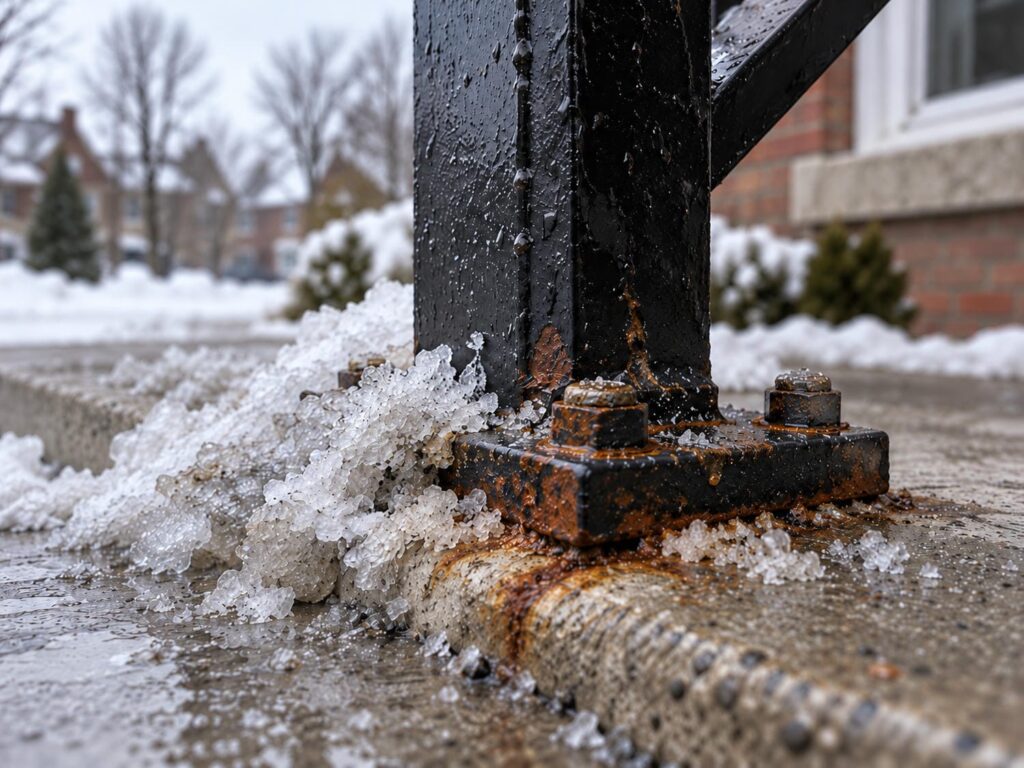
The damage never starts in the middle of a picket, the part you look at. It starts where the coating is thinnest, broken or unreachable. On a steel railing that means the bottom of the posts, and every cut, weld and hole the fabricator made.
Post Bases and Base Plates Sit in Brine All Winter
The lowest point on the railing is where slush lands, where meltwater pools, where the shovel hits, and where the fasteners sit. Between the base plate and the concrete sits a crevice that holds brine long after everything above it has dried. The same federal guidance names the culprits for metal kept outdoors: standing water, high humidity, and water drawn up from the ground. The bottom 300 millimetres of a railing beside a salted walk is not in the same environment as the top rail. That is the part to specify hardest.
Welds, Cut Ends, Drilled Holes and Mixed-Metal Joints Are Bare Steel
Four defects, four predictable consequences. A weld that was ground and not re-primed is a bare spot waiting for winter. A picket cut on site, or a hole drilled after coating, is bare steel by definition. A hollow post that was never sealed, or sealed and then drilled, takes water in and rusts from the inside out where no brush reaches.
The fourth is mixed metals. Where two different metals meet in a wet joint, the weaker gives way first, right at the point of contact. The clearest case is a galvanized railing on plain steel fasteners: the zinc protects the railing, nothing protects the bolt, and the first rust shows as a ring around each fastener head. Hardware carries its own hot-dip galvanizing standard because a fastener corrodes on its own terms.
The Longevity Numbers Your Supplier Quotes Are for a Different Winter

Here’s the catch. Two numbers get quoted at homeowners shopping for a steel railing: a service life in decades, and a salt-spray hour count. Neither is a statement about a salted Toronto porch.
The 72 Year Figure Belongs to Heavy Steel in Five Test Environments
The galvanizing industry publishes 72 to 73 years to first maintenance for hot-dip galvanized structural steel thicker than 6.4 mm, in the harshest of the five test environments it measured, which it calls industrial. Residential railing sections are thinner than that. In that figure, first maintenance means 5 per cent of the base steel is showing rust, with 95 per cent of the coating still intact. The industry’s own clock stops when rust becomes visible.
The Harshest of Those Five Is Still Only Some Effect of Chlorides
The same association maps its five test environments onto the international corrosivity scale. All five land in the band the scale describes as some effect of chlorides, with examples running from 1 to 30 kilometres from the ocean. The scale carries three bands above that, up to deposits in salt-water spray. So those long service life figures describe the bottom of the chloride ladder. The zinc works by building a stable surface patina, and the industry names chloride as one of the two things that destabilize it.
Hours in a Salt Spray Cabinet Are Not Years on a Porch
The salt spray test is a real and useful comparison under controlled conditions: a fine mist of 5 per cent salt solution, at room temperature, for a set number of hours. Its own governing standard says it does not prescribe how to interpret the result for a product, and that natural-environment performance has seldom been correlated with salt spray results used on their own. For galvanized steel the industry goes further: the cabinet prevents the protective patina forming, so it accelerates the wrong mechanism. Hours in a cabinet are not years on a porch. Ask what the hours are being compared against.
Rust Showing and a Railing Weakening Are Two Different Clocks
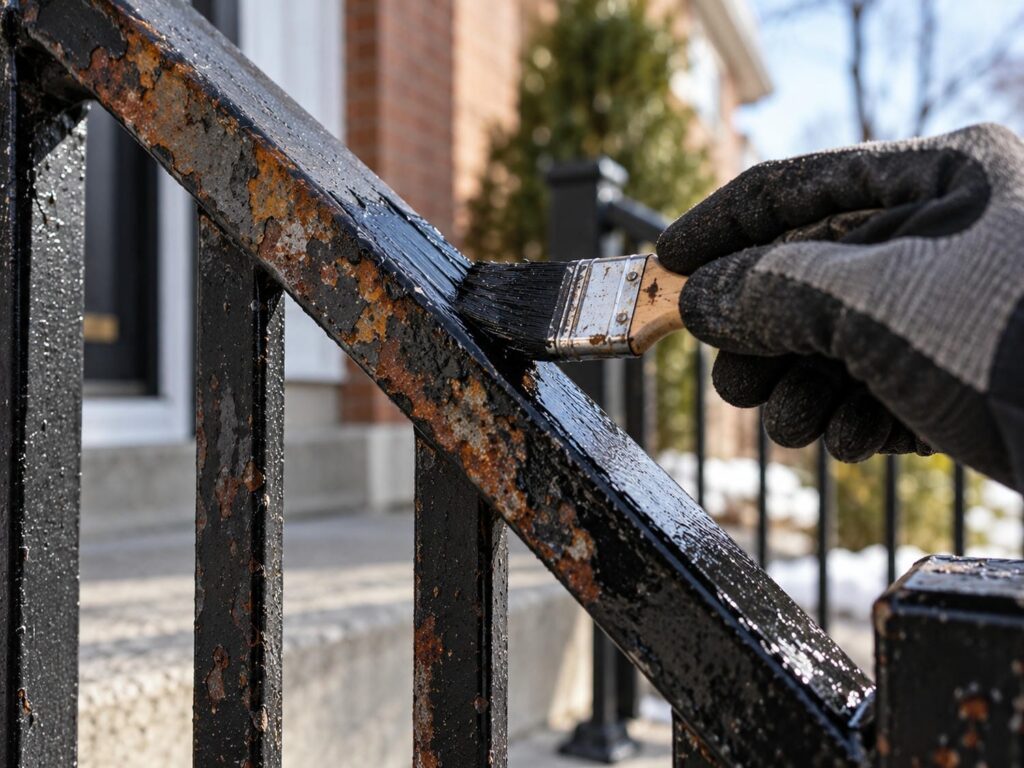
Two clocks run on a steel railing. One measures how long until the damage is visible. The other measures how long until the metal has lost enough to matter. The rust stain at your post base is the first clock, much the faster of the two.
Visible Rust Is the Maintenance Clock
Five years is a realistic horizon for salt damage to become visible on a painted steel railing in a salted Toronto setting, starting at the post bases, the welds and the cut ends. That is the appearance clock. The galvanizing industry’s own definition agrees: its clock stops at 5 per cent visible rust, with the protection still mostly in place. So visible rust is a trigger to act, not a verdict. Whether to repair or replace is a separate judgement, and it turns on the signs that it is time to replace an exterior railing rather than on the stain.
Losing Metal Is the Slower Clock
Once the film is breached, bare low carbon steel loses roughly 25 to 50 micrometres of thickness in its first year in an urban atmosphere, and 50 to 80 where more chloride reaches it. Those are first-year figures, and the losses usually slow after that. On the metal you can see, a stain appears long before much metal has gone. The parts that decide it are the ones you cannot see. What the metal has left depends on how thick it was to start with, which is a number on the shop drawing. Ask for it.
Painting Over Rust Hides It and Keeps It Going
The federal conservation guidance is blunt: corrosion can still proceed under new paint, and may remain undetected until great damage has been done. Protective coatings are not a permanent barrier, and they cannot undo salt contamination. So sanding the worst of it and brushing on fresh paint seals the salt and the moisture in. The next time it shows, it shows bigger, and somewhere the paint could not reach.
What Is Under the Finish Decides the Answer
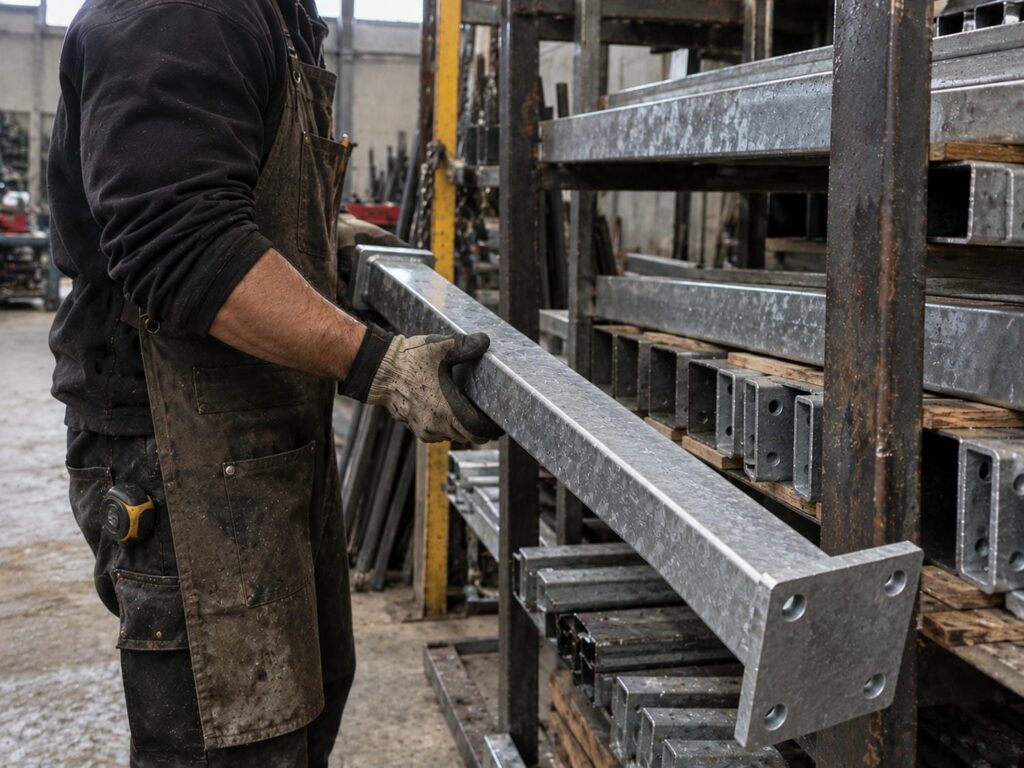
Paint and powder work by excluding water. Two railings sold as powder coated iron can differ by years, and the difference is what sits under the film. On bare steel the film is the only line of defence, and once breached the steel has nothing behind it. On galvanized steel there is zinc behind it, corroding at roughly one thirtieth the rate of bare steel in the same conditions.
Why the Same Word, Galvanized, Gives Answers From 5 Years to Over a Century
The hot-dip galvanizing specification sets a minimum average coating by product class as well as by steel thickness. A railing is pipe and tubing for the posts and top rails, strip and bar for the pickets and shoe rails, and plate for the base plates. It is not structural steel shapes. Tube gets the thinnest grade for everything up to a 3.2 mm wall, and the specification never asks for more than 75 µm on tube at any thickness, where the published longevity figures are calculated on 100 µm. These are minimum averages, so a real coating is usually thicker: a floor, not a measurement.
Zinc goes at 0.7 to 2.1 micrometres a year at the lowest chloride band, 2.1 to 4.2 at the next, and 4.2 to 8.4 at the highest. The top row is the thinnest coating the specification permits, not a typical railing. The right-hand column is the band the published scale illustrates with jetties, offshore structures and salt-water spray. Which row applies depends on the wall thickness on the shop drawing, so ask for that figure.
Divide the starting zinc by the published rate for each level of chloride, and the same word, galvanized, produces answers from 5 years to over a century. These years are division, not a lookup. The scale runs from a trace of chloride on the metal up to standing in salt-water spray.
| Zinc on the steel at the start | What that is on a railing | Some effect of chlorides: 1 to 30 km from the ocean | Substantial chloride effect: within 1 km of the ocean | Significant chloride effect: jetties and offshore |
| 45 µm | Tube up to a 3.2 mm wall, or bar under 1.6 mm | 21 to 64 years | 11 to 21 years | 5 to 11 years |
| 65 µm | Bar from 1.6 to 3.2 mm | 31 to 93 years | 15 to 31 years | 8 to 15 years |
| 75 µm | Tube from a 3.2 mm wall up, or bar from 3.2 to 16 mm | 36 to 107 years | 18 to 36 years | 9 to 18 years |
| 100 µm | Heavy structural steel. The specification never asks for this much on tube | 48 to 143 years | 24 to 48 years | 12 to 24 years |
Nobody has published which column a Toronto porch railing belongs in, so the useful question is where the slush lands on yours.
Paint Over Galvanizing Outlasts the Sum of Its Parts
A duplex system, paint or powder over hot-dip galvanizing, is published as delivering 1.5 to 2.3 times the combined life of galvanizing and paint used separately, in a system nobody maintains and where the paint is allowed to wear away. Where an owner does maintain the paint, the published result is a maintenance cycle 1.5 to 2 times longer than paint alone. The topcoat slows the zinc being consumed, and the zinc under the topcoat takes the hit instead of the steel. So a breach in the film exposes zinc rather than bare steel.
Aluminum Pits Instead of Rusting, and That Is Not the Same as Immune
Aluminum holds a thin oxide film that re-forms when it is damaged, which is a real advantage over steel on a salted street, although chlorides in common salt attack that oxide layer rapidly, producing a white powder and pitting the surface. Aluminum is not immune, it fails differently. Rust expands and lifts a coating from underneath. Aluminum’s corrosion product does not. What the finish on an aluminum railing does as it degrades is a separate subject, and what a failing powder coating looks like before rust appears covers it.
What It Costs to Get This Wrong, and What to Put on the Quote
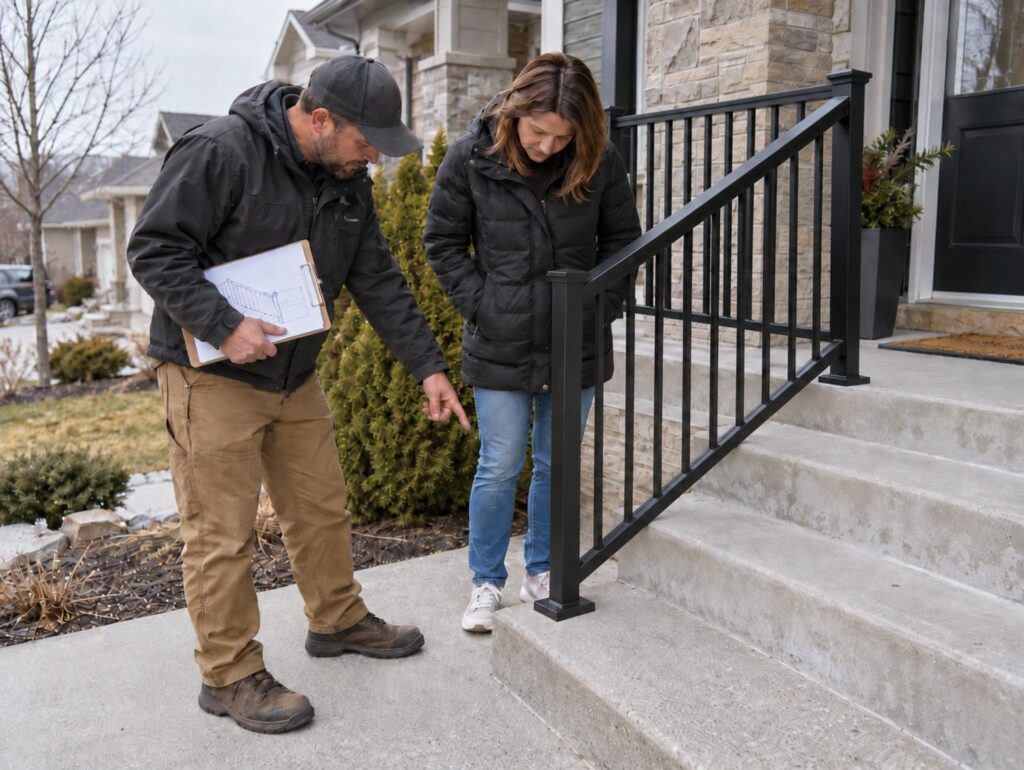
The cheapest version of this problem is the one you specify out of existence before anything is fabricated. The expensive version is the one you find in year six, when the fix is a new railing and a concrete repair.
What a Cheaper Railing Gives Up, and What the Second One Costs
What drives the cost up is specific: galvanizing before finishing, heavier sections, sealed and drained post bases, shop fabrication instead of site cutting, and matched hardware. What a cheaper railing gives up is just as specific: the zinc, the section thickness, and the sequence. The arithmetic you can do yourself is the second railing: the full price again, plus removal, plus the concrete repair where the old base plate sat. So have galvanizing quoted as a separate line item, and the premium stops being a guess. Over 15 years of installing railings across the GTA, the premium has never been the expensive part.
A railing in bad repair is also a property standards matter in Toronto, enforced on complaint. The City’s current set fines run to $1,000 for failing to comply with an order and $750 for failing to comply with a standard.
Ask What the Steel Is Coated With, by Name, on the Quote
Four asks, each with its reason. Ask whether the steel is galvanized or only painted, because that is the difference between one line of defence and two. Ask which specification the galvanizing was done to. Canada has its own standard for galvanizing fabricated and irregularly shaped steelwork, so ask whether the railing was galvanized to it and who did it. Ask for the section’s wall thickness off the shop drawing, since the zinc minimum is tied to it and to the product class. And ask that every cut, weld and drilled hole happens before coating, because any one of them done afterwards is bare steel that no maintenance repairs. Our railings are made in Canada, and a shop working from its own drawings can answer all four.
If Your Replacement Needs a Permit, It Is Reviewed Against the 2024 Code
If your replacement needs a building permit, the drawings are reviewed against the 2024 Ontario Building Code, which is the edition in force now and not whichever one applied when your porch was built. Nothing obliges you to upgrade a railing that is still in good repair. So the question worth asking is what the new one has to satisfy, not what the old one did.
In Toronto, guards, handrails and their supports have to be kept in a safe condition and in good repair, and that obligation does not come with a reminder or a date. One rule is for new work. The other is for the railing you already own.
Toronto’s permit lists do not mention replacing a railing on its own, in either direction. So the first call is to Toronto Building, and the question is narrow: does this job need a permit, and if so, what goes on the drawings? Ask for the answer by email. Where the porch sits on a designated property, a Toronto building permit for front porch railing work brings conditions of its own.
Build for the Salt Before the First Winter
It all comes down to one decision made before fabrication: what sits under the finish, and in what order the work was done. We specify the substrate and the coating sequence for the exposure a railing will actually face, and we detail the base so water drains instead of sitting in a crevice. GTA Railings makes its railings in Canada, our crews are certified and insured, and every railing carries a 2 year warranty on all materials and workmanship. If you are replacing a porch or walkout railing, our Toronto custom railing installers will look at where the slush lands before anything is cut.
Start with the specification rather than the repair: get in touch about a steel railing that will take a Toronto winter.
Frequently Asked Questions
Nobody publishes a rule for how much rust is too much. What a guard has to do is hold a person who falls against it, and that strength lives in the posts, the base plates and the fasteners, not in the surface you see. Surface rust on a picket and a corroded post base are very different situations. Have someone look at the connections.
Three things usually explain it. One, what is under the finish: galvanized steel and painted bare steel are different products sold under the same description. Two, the order the work was done in, because a hole drilled after coating is bare steel. Three, exposure, since the side of the walk that catches plow slush takes far more salt.
Stripping and re-coating reaches only the surfaces a brush can reach, and salt that has worked into a crevice or the inside of a hollow post is not one of them. A fresh coating over a contaminated base can fail where the old one did. Hot-dip galvanizing needs a bath, so the railing has to come off and travel. The base of the post usually decides whether it is worth doing.
Judge the assembly by its steel. The aluminum pits where salt gets through its oxide film, but that film re-forms and the powder it leaves does not expand and lift coatings the way rust does. The steel posts are the part that loses section, and their bases stand in the slush. Expect the joint between the two metals to need attention before either metal does.
Yes, and it is the cheapest thing available to you. Rinsing takes the salt off rather than sealing it in, which is the opposite of what a coat of fresh paint over rust does. The steps for maintaining your custom railings are worth following in full.
Not straightforwardly. Toronto’s annual average temperature has risen by 3.8 degrees since 1841, but a warmer city can mean more days hovering at zero instead of sitting below it, and a longer season when surfaces are wet rather than frozen solid. Wet and salted is the condition that corrodes steel. Milder is not the same as drier.