
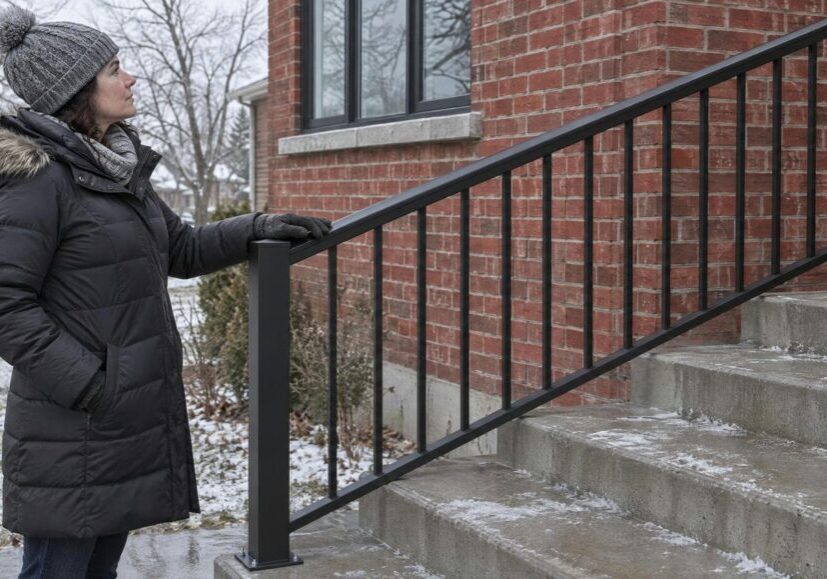
Wrought iron vs aluminum railings sounds like a choice between two metals. It is closer to a choice between a material and a word. Real wrought iron is no longer made, and the term now gets used for ornamental work in mild steel, so the first question is what the ferrous option in front of you actually is.
Aluminum is easier to pin down, because aluminum railings are extruded profiles assembled to a manufacturer’s drawings. So the comparison worth making runs through six questions: what the metal is, what Ontario asks of both, how each one behaves under road salt, what happens at the joint, what each costs to own, and when the ferrous answer is the right one. We fabricate and install both materials, so neither one is the answer we need you to pick.
What “Wrought Iron” Means on a Railing Quote
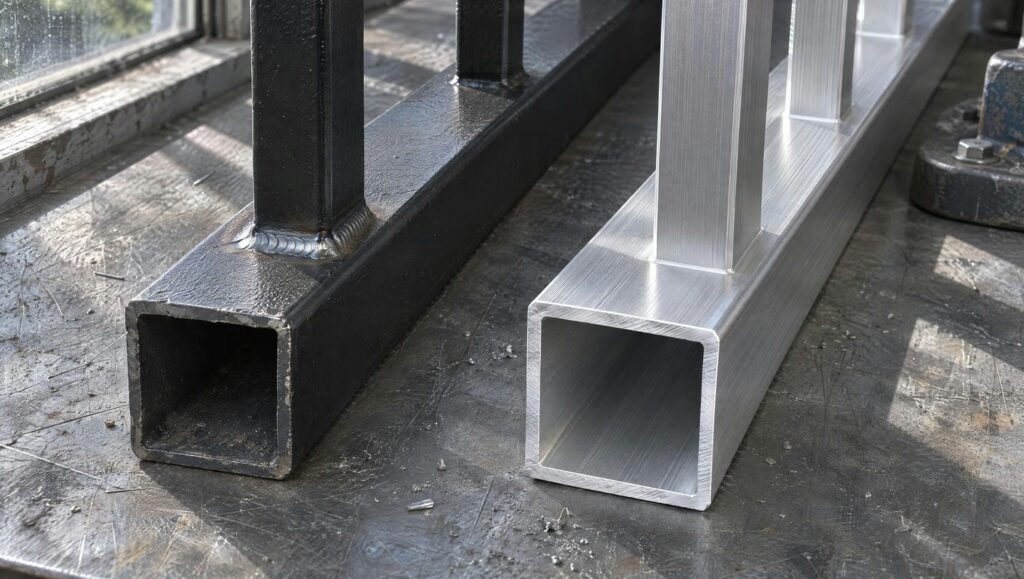
The word on the quote is doing more work than the metal is. Before you compare two materials you need to know which two, and on the ferrous side the name does not settle it. What the word covers, what an aluminum railing is made from, and what belongs on paper: those three decide the rest.
The Metals That All Get Called Iron
The word iron covers more than one metal. Conservation guidance on historic ironwork is blunt about the term: wrought iron is often used for any ornamental work in mild steel, and wrought steel would be more accurate. The same guidance says real wrought iron is no longer made and comes only from recycled material.
Real wrought iron is described there as iron close to its pure form: ductile, highly workable, and more resistant to corrosion than mild steel. Cast iron is a different material again, hard and durable, castable into intricate shapes, and more resistant to corrosion than wrought iron. So when a railing is sold as wrought iron, ask what the metal is, and have the answer on the quote.
What an Aluminum Railing Is Made Of
An aluminum railing is an extruded system. Posts, top rails and pickets are pulled through a die as catalogue profiles, cut to length, assembled to the manufacturer’s drawings, and finished. A ferrous railing is a made-to-order fabrication: tube, bar and flat stock cut, welded, ground and coated in a shop for one house.
That difference decides more than it looks. A system brings its own engineering and its own replacement parts, and it can only build what the catalogue contains. A one-off fabrication brings the shop’s engineering and no parts list, and it can be built to any shape you can draw.
What Has to Be Settled Before the Comparison Means Anything
Until the quote names the metal, you are comparing aluminum against a word, and that word covers metals that behave differently from each other. Wrought iron, cast iron and mild steel are not one product with three names.
Four things are answerable before anything is cut: what the metal is, how the finish was applied and in what order, what the joint is made of, and who will repair it. Get those four on paper and most of the argument between the two quotes goes away. Everything after that is detailing, and detailing is where railings fail.
Does Ontario’s Building Code Prefer One Metal?
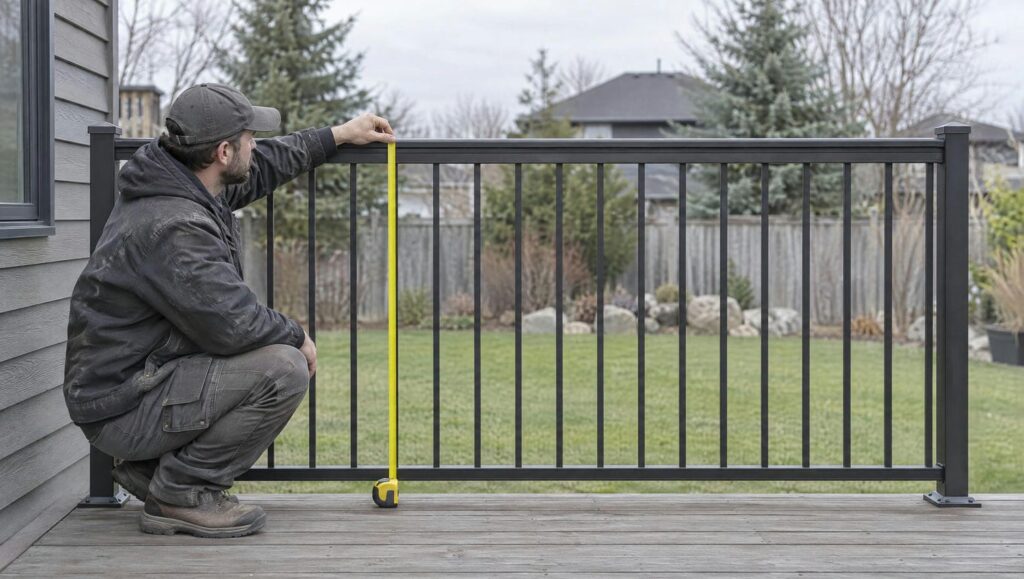
Short answer: the Code asks what a guard has to do, not what it is made of. The guard rules set heights, openings, loads and climbability, and the one material they single out is glass. Four things follow from that, and all four show up on a quote.
What the Guard Rules Actually Control
The guard rules set when a guard is required, how high it has to be, and how large the openings may be. They also set the loads it has to resist, and they require that it must not be climbable. Every one of those is written as something the guard has to do. The material the guard rules name is glass, which has to be safety glass of a named type, and glass guards carry a supplementary standard of their own.
A steel guard and an aluminum guard are measured against the same requirements, and your quote should be able to say how yours gets there.
The Wood Shortcut Neither Metal Uses
The Code lets a guard satisfy the load requirement in more than one way. One of those ways is to build the guard to the Province’s supplementary standard for guards, which is then deemed to satisfy that requirement. That standard states its own scope in a single sentence: “This Supplementary Standard includes details for the construction of wood guards.”
So that route is written for wood. A steel railing does not take it, and neither does an aluminum one. Both get there the same way. That establishes the standard’s scope and nothing more: whether a metal guard needs an engineer’s seal, and what your building department will ask to see, are separate questions. A quote that treats one metal as exempt from proving itself is worth a question of its own.
Where the Code Names Each Metal
Outside the guard rules, in the part of the Code that deals with structural design, there is a named design standard for structural steel, CSA S16, Design of steel structures. There is a different one for aluminum, CSA S157/S157.1, Strength design in aluminum. One for each metal.
That is the structural design part of the Code, and a house deck guard is normally designed under the housing part, so these are not the articles a residential plans examiner reaches for first. Read them as evidence that the Code has a design route for each metal. Which one applies is a question for whoever seals the drawings rather than a reason to prefer a metal.
Who Works Out the Spans and the Anchoring
For either metal, post spacing and anchoring come out of the system’s engineering or the fabricator’s, not out of a provincial lookup table. The Province’s prescriptive post spacings are wood figures, so they do not transfer to metal. The numbers that decide spacing and anchoring come from the engineering behind the system you are buying, which is why asking to see it is a fair question.
Weight is the other thing that shows up on site. For the same shape, the aluminum part weighs roughly a third of what the ferrous one does, so a long fabricated steel run needs more hands, more substantial anchoring and more support while it is held in place.
How Each Metal Corrodes Outdoors
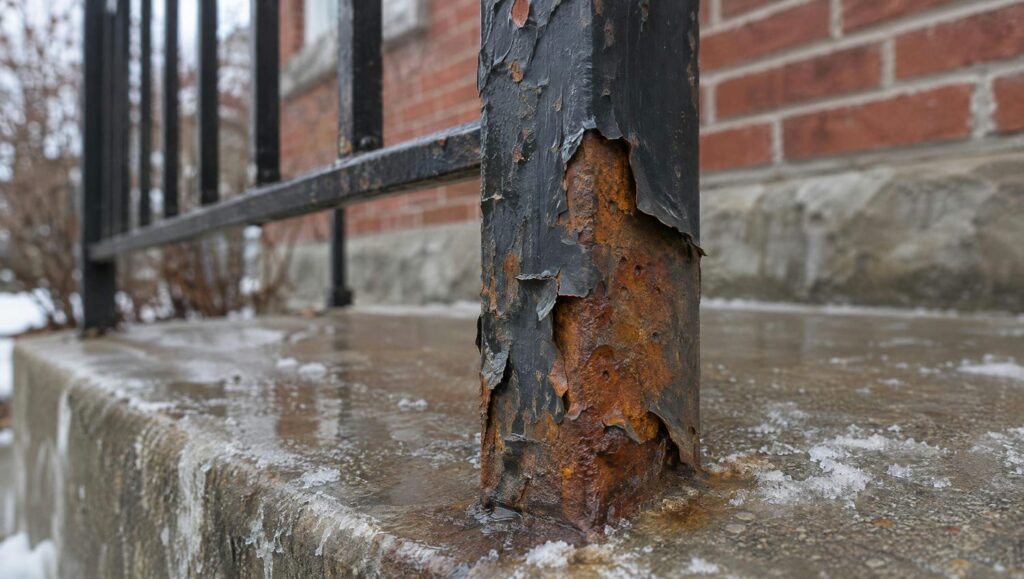
The two metals do not simply corrode at different speeds. They corrode in different ways, and the difference decides what a failure looks like and what putting it right involves. One spreads across the section. The other pits in one spot.
Rust Spreads, and It Takes the Metal With It
Pure iron is chemically reactive and corrodes quickly in moist air, and while no railing is made of pure iron, the behaviour carries. Active iron corrosion shows as new bright orange corrosion, or as flakes falling off a surface that is left with pits and depressions with orange spots in their centres. Rust does not sit on the metal, it takes the metal with it.
It starts where water is held. Corrosion tends to occur at water traps, where rainwater is trapped and the metal cannot dry out. Road salt and slush speed every part of that, which is why what Toronto winter salt and slush do to an iron railing shows up first at the post bases and the welds.
Aluminum’s Oxide Film, and What Road Salt Does to It
In air, aluminum forms a thin, protective, corrosion-resistant oxide layer on its surface, which is a statement about the element rather than a promise about a finished railing. The film is stable and prevents further deterioration, and chlorides in common salt rapidly attack that layer and leave a white powdery corrosion product, with pitting wherever the film has broken.
Aluminum contains no iron, so it does not rust. It does corrode, and chloride is what starts it. The honest difference is that the film re-forms, and aluminum’s corrosion product does not expand and lift the coating the way rust does, so the damage stays local.
What Happens Where Aluminum Meets Steel
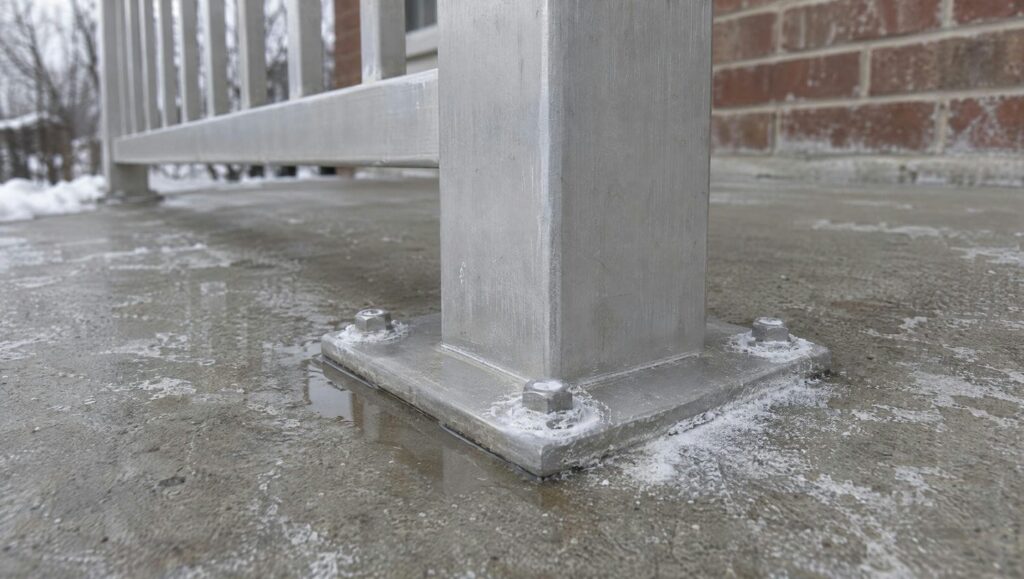
Most of the corrosion a railing owner actually sees starts at a connection, not in the middle of a picket. Two things decide what happens there: which metal gives way when two of them touch, and whether water can sit in that joint at all.
Which Metal Gives Way in a Wet Joint
Conservation guidance publishes an ordering of metals, from most noble to least noble. In it, mild steel and cast iron sit above aluminum alloys, with only zinc below. Where two metals touch and both are wet, the less noble one corrodes faster than it would alone.
So in a wet joint where aluminum meets steel, the aluminum gives way. That is the opposite of what most buyers expect. The ordering says which metal goes first, not how fast, and no published figure puts a rate on it. It needs moisture, so a dry interior stair connection is not the same situation as a post base sitting in slush. It also settles nothing about which fastener to specify.
So ask what the brackets, anchors and fasteners are made of, and whether water can sit in that joint. That question belongs on the quote.
Where the Water Sits Is a Design Choice
The most useful line in Canadian building research on this was written in 1961, and the age is the point: a National Research Council building digest states that faulty design is the first major factor leading to the corrosion of iron and steel in buildings.
The same digest advises avoiding different metals in one system, to eliminate galvanic corrosion where they touch. It also says aluminum embedded in mortar should be protected with a bituminous coating, which is advice about embedment in buildings generally rather than about guards, after aluminum conduit set into concrete containing calcium chloride failed early.
That cuts against aluminum fairly. Setting an aluminum post directly into fresh mortar or concrete is its own problem, and a post base that drains is worth more than the choice of metal above it.
What Each One Takes to Keep
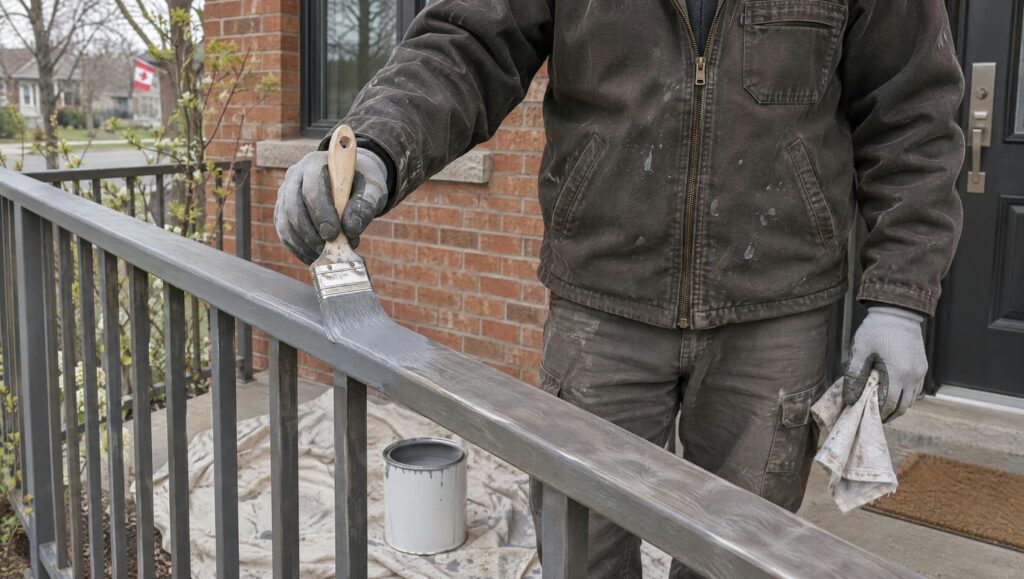
Nobody publishes how long a railing lasts on a Toronto porch, because it depends on the metal, the finish and where the slush lands. What you can settle before you buy is the finish specification and who stands behind it, in writing. Upkeep works differently on each material.
Keeping a Ferrous Railing Is Coating Work
Bare ferrous metal corrodes, so on a steel railing the coating is the part doing the protecting. Looking after the railing means looking after the coating, and that is closer to a program than a touch-up.
For historic ironwork in Scotland, conservation guidance describes complete repainting as two coats of a zinc-based primer, one coat of micaceous iron oxide, and two coats of gloss paint. In Scotland’s climate, painting is discouraged from November to February, when the damp and cold prevent paint curing properly. For ferrous metal in museum care, the published advice is a program of inspection and maintenance rather than a frequency, with coatings removed and reapplied periodically and fresh rust treated when it appears. Neither one is a schedule for your porch. Both tell you what kind of work you are signing up for.
An Aluminum Railing’s Upkeep Sits in Its Finish
Two quotes can name the same colour and mean different coatings. The specification for a metal railing’s coating is a buying decision rather than a compliance one, which is exactly why it belongs on the quote in writing.
So the aluminum question sits in the finish, and the finish is a separate decision from the metal. Anodizing and powder coating are different processes with different specifications, and the differences between anodized and powder coated aluminum finishes change what you are buying and what it will need later.
On a ferrous railing, what sits beneath the paint matters more than the paint itself. Either way, get the finish specification named on the quote, and the warranty terms with it.
Repairs, Years After the Install
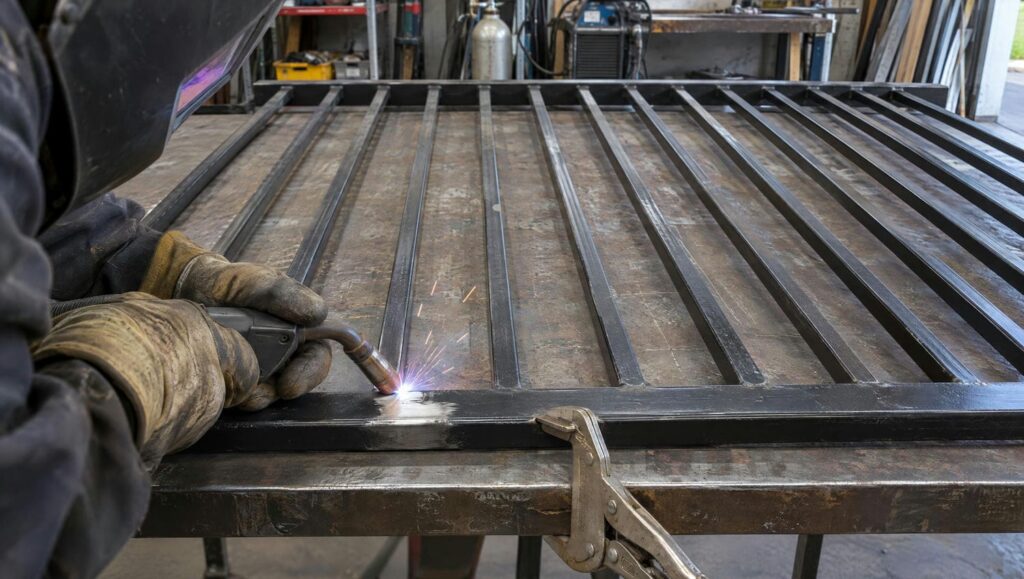
A railing’s second life matters more than most buyers expect, because a shovel, a car bumper or a falling branch is usually what ends a section. Both materials can be repaired. They come back to the shop by different routes, and those routes cost different things.
Fixing a Steel Railing Is Shop Work
The people who repair real ironwork for a living work to a strict rule: replacements are like-for-like, and only sections that are missing or beyond repair get replaced. In historic ironwork, essential repairs to wrought ironwork should be done by a suitably qualified and experienced professional using traditional detailing and techniques. Cast iron welding should only be done off site by experienced craftspeople, and fractures can sometimes be repaired with screws and dowels instead.
On a new steel railing the practical read is simpler. A damaged section can be cut out, re-welded and re-coated by any competent shop, and the colour and gloss of the repaired coating will not fully match the rest. Any cut, weld or hole made after coating is bare metal, so the order the work was done in is a real question to ask.
Repairing an Aluminum Railing: Parts and Profiles
A damaged part can be swapped for an identical factory part, which is cleaner than a weld repair, but only while that profile is still in the manufacturer’s catalogue. A scratch through powder coating is a local defect rather than a general one. Ask whether the profile is a current line, and whether parts are held in Canada.
A field weld on structural aluminum is specialist work rather than something to hand to a general handyman. In Canada the fusion welding of aluminum is certified under its own standard, CSA W47.2, separately from steel, and that certification covers welding supervisors, approved procedures, qualified welders and a company audit. Ask who would do a repair, and what they are qualified on.
Wrought Iron vs Aluminum Railings Side by Side

The two materials do not sort into better and worse. They differ in what fails, where it fails, and what putting it right involves, and that is what decides which one belongs on a given project.
| Question | Railing sold as wrought iron | Aluminum railing |
| What the name covers | Conservation guidance says the term is used for ornamental work in mild steel, and that real wrought iron is no longer made and comes only from recycled stock | Extruded aluminum profiles from a system catalogue, assembled to the manufacturer’s drawings |
| How it corrodes | Rust spreads across the surface, then flakes away and leaves pits and depressions behind | An oxide film protects the surface and re-forms, and chloride in road salt attacks that film and causes pitting where it breaks down |
| In a wet joint with the other metal | The ferrous side sits higher in the published order of metals, so it is not the side that gives way | Aluminum sits below mild steel in that order, so where the joint stays wet the aluminum corrodes first, and a dry interior connection is a different case |
| Fixing a damaged section | Cut out and remade in a shop, and the repaired coating will not fully match the rest | Swapped for an identical factory part, but only while that profile is still in the catalogue |
| When it is clearly the right answer | Matching existing ironwork, geometry the quoted system does not carry, and interior stairs where road salt is not the deciding factor | Exterior porch, deck and balcony guards that take road salt, where upkeep and replacement parts matter most |
What Actually Drives the Price Difference
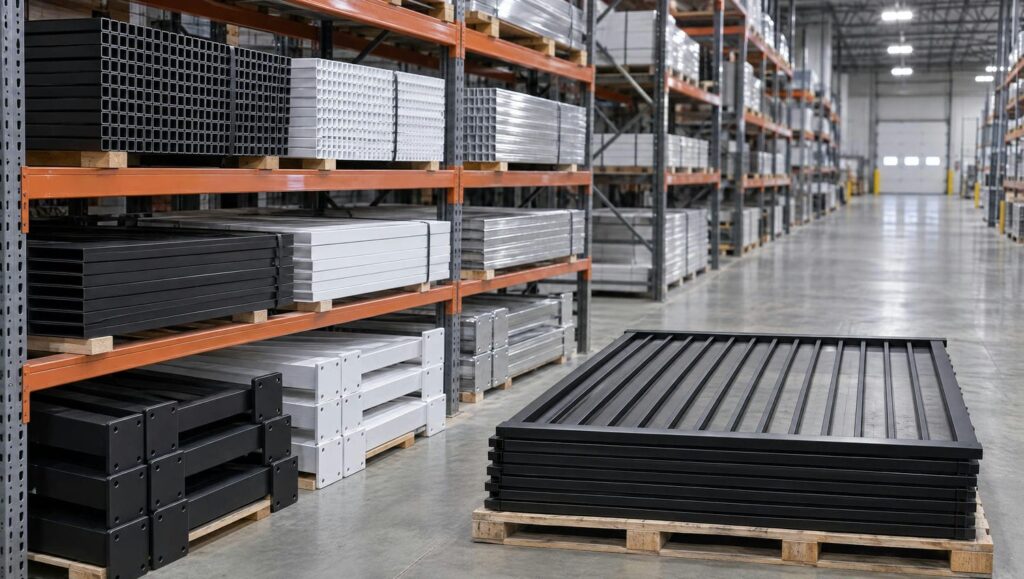
Two quotes for the same railing can sit far apart, and some of that gap is the material rather than the company. Which railing materials cost the least installed is a useful baseline, and what moves the number from there is specific to each material. Name those drivers and you can compare the quotes instead of the totals.
Made to Order Against a Catalogue System
One of them is shop hours. The other is parts. A ferrous railing is measured, drawn, cut, welded, ground and coated for one house, so the cost follows the labour and the complexity of the design. A system railing is parts and assembly, so the cost follows the length, the number of posts, the mounting condition and the options you choose.
On a ferrous railing, design complexity is the variable that moves the price. On a system railing, the site conditions and the mounting details are. Metal prices move as well, and they do not move together, so a railing quote is a snapshot and it is fair to ask how long the price holds.
The Finish, the Hardware, and the Engineering
Three line items quietly separate two quotes for the same railing: the finish specification and the order the finishing was done in, the hardware and fasteners at every connection, and whose engineering stands behind the spans and the anchors. None of the three is visible in a total.
Then there is the cost that lands years later. A ferrous railing comes back for coating work. A system railing comes back for a part that has to still exist. Both are real costs of ownership, and neither appears on the install quote, which is why the cheaper number on the day is not always the cheaper railing.
Where the Ferrous Answer Is the Right One
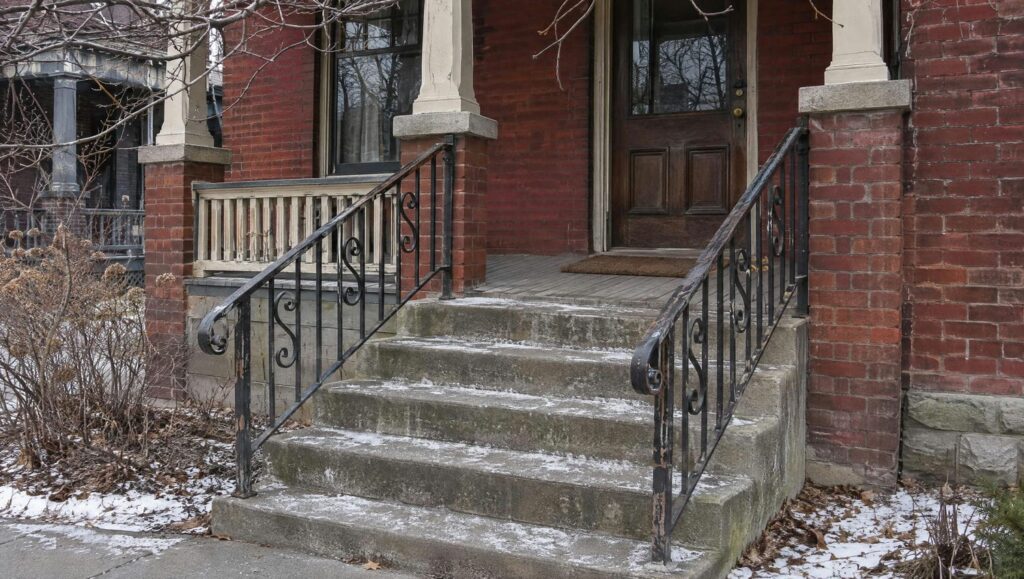
There are cases where the ferrous option is the right answer, and they are specific rather than sentimental. Not all of them involve heritage. One of them is a shape a catalogue does not carry, and another is an ordinary interior stair.
Matching Existing Ironwork on a Designated Property
Ontario’s published principles for conserving built heritage ask that materials be repaired or conserved rather than replaced except where absolutely necessary, and that repair be done with like materials. They also ask that new work be distinguishable from old, and note that continuous care prevents the need for restoration later. Those are principles in common use in Ontario’s heritage sector, not a by-law and not a permit condition, and what any given owner must do comes from their municipality.
The material consequence is direct. Where the existing fabric is ironwork, repair with like materials means ferrous. Replacing porch railings on a heritage designated property puts approvals ahead of fabrication, so the material decision lands early.
Substitutes Are Not Equivalent Where the Ironwork Is the Heritage
Where the ironwork itself is what is being conserved, conservation guidance names cast aluminum, steel, fibreglass and plastic as unsuitable substitutes with a shorter lifespan. That is about substituting materials in historic ironwork. It is not a claim that an aluminum railing has a shorter service life than a steel one on an ordinary porch.
The comparison there is drawn against real wrought iron, which the same body describes as more resistant to corrosion than mild steel. If you genuinely are matching original ironwork, real wrought iron still exists as recycled stock, and it is a specialist order rather than rack stock, so ask early, because it changes the schedule as much as the price.
When the Shape Is Outside the Catalogue
A system railing can only be built from what its catalogue contains. If the system you have been quoted does not carry the part, the shape decides the material. That covers a curved run, a radius stair, a landing that turns at an odd angle, a gate built into the railing line rather than hung beside it, a post spacing forced by what is underneath, and an infill pattern the catalogue does not offer.
Some systems do carry curved and radius components, so the question is always about the system in front of you rather than about aluminum in general. A fabrication is drawn to the opening it has to fill. The shape stops being a constraint and becomes a choice.
Forge Work, Cast Detail and Solid Sections
Ferrous metal is forge-workable and castable into intricate shapes. That is why hand-forged scrollwork, reproduced period profiles and heavy solid sections that read as solid are ferrous jobs. Those are design reasons, and they are good enough on their own.
What they are not is a performance argument. Strength lives in the sections and in the anchors, not in the name of the metal. If the reason for choosing ferrous is that it looks more expensive, that is a preference rather than a specification, and preferences get expensive quietly. Matching something that already exists is a specification, and it is worth paying for.
Interior Stairs, Where Salt Is Not the Deciding Factor
An interior stair is not exposed to road salt and standing slush the way an exterior guard is, so the corrosion case that drives the outdoor decision carries much less weight indoors. Salt still comes in on boots and lands on a front-hall stair. It simply is not what decides the material there.
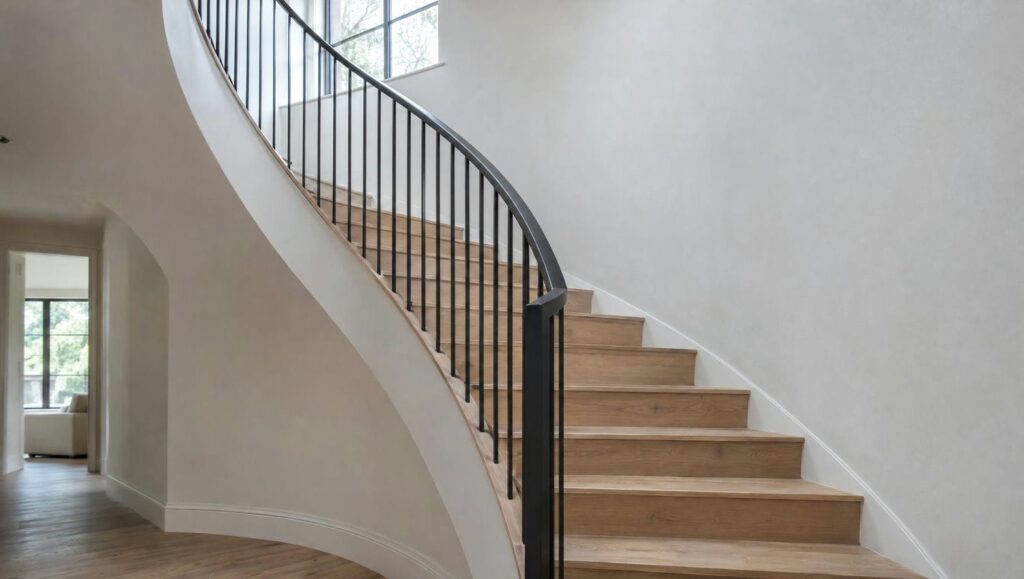
What decides it instead is how the railing looks in the room, how the top rail feels under your hand, how heavy a section the stair wants to carry visually, and what the stair’s geometry actually needs. A curved or winding interior flight is the clearest case of all: if the system does not carry the part, a fabrication does.
Matching the Metal to Your Project
Here is the decision rule, and it is a rule rather than a verdict. One set of conditions points to aluminum. Another set points to ferrous, and the conditions are specific enough that you can check your own project against them in a minute.
When Aluminum Is the Straightforward Choice
Aluminum is the straightforward answer on a new porch, deck, balcony or walkout guard on an ordinary GTA house. It fits where the design is not reproducing anything, where the railing will take road salt and slush every winter, and where you want the upkeep to be cleaning rather than a coating program.
The parts argument belongs here too. A system that is still in production is a system you can buy a replacement picket for in year twelve, and that is worth more on a guard facing the street and the shovel than it is on a stair inside the house.
When the Ferrous Option Earns Its Place
The ferrous option earns its place in five situations: matching existing ironwork, a property where the approval settles the material, a shape or a run the quoted system does not carry, forge or cast detail you actually want, and an interior stair where salt is not what decides it.
Outside those five, the choice usually turns less on the metal than on the detailing, the finish specification and the joint. All three are settled on paper, before anything is cut. That is the part of the decision you control, and it is the part most quotes leave vague.
The Questions That Belong on Your Quote
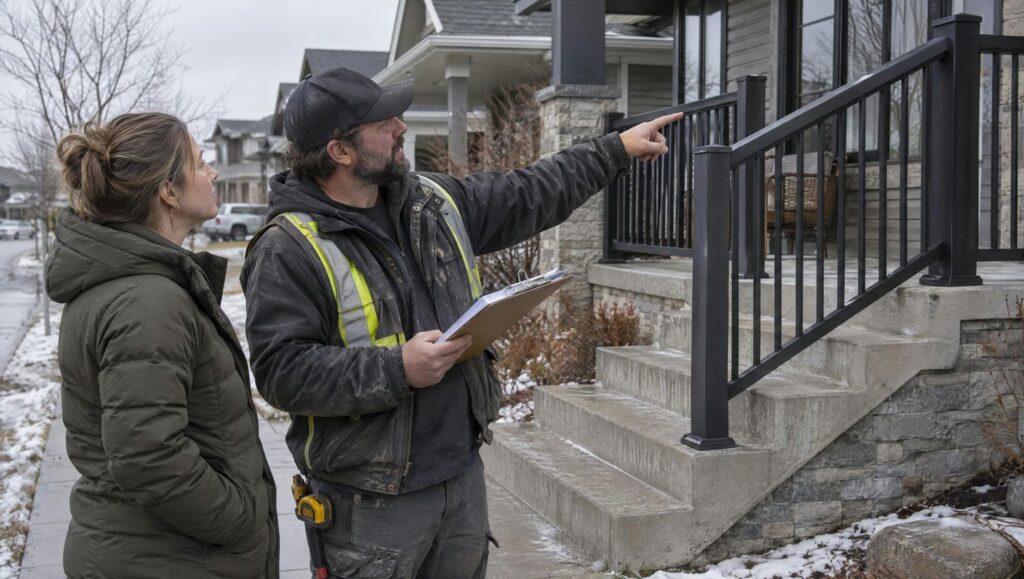
Six questions sort out two quotes faster than any comparison chart does. Ask every one in writing.
- What metal is it, named on the quote rather than described as iron.
- What the finish is, named as a specification, and when in the build it was applied.
- What the posts land in, and whether water can drain out of that joint.
- What the brackets, anchors and fasteners are made of.
- Whose engineering covers the spans and the anchoring, and whether you can see it.
- Who repairs it in ten years, what they are qualified on, and whether the parts will still exist.
Getting the Material Decision Settled Before Anything Is Cut
The material decision is won or lost on paper, in the shop, before anything is cut. GTA Railings works that way: our railings are made in Canada, every job carries a 2-year warranty on all materials and workmanship, and we have been fabricating and installing in the GTA for over 15 years. We build in both materials, so we will tell you when the ferrous answer is the better one.
If you want custom aluminum railings drawn to your porch, or a ferrous fabrication for a shape no catalogue carries, we will price both and show you the detailing.
When you are ready to talk to us about your railing, bring the two quotes you already have. We will go through the metal, the finish and the joints with you, line by line.
Frequently Asked Questions
Yes, but not as new metal. Conservation guidance says wrought iron is no longer made and is only available as recycled material, and that recycled stock can be sourced. In practice that makes it a specialist order rather than something a shop keeps on the rack, so it needs asking about early in the project. If matching original ironwork is the point, the lead time will matter to you as much as the material does.
It turns on three things you can actually control, and the metal is not first among them. The finish specification and how carefully it was applied come first. Whether water can sit in the joints and at the post bases comes second. Where the slush lands on your particular porch comes third. Get the finish specification and the warranty terms in writing before you pay a deposit, because those are the parts that are still negotiable.
No, because there is no iron in it, and that is not the same as saying it does not corrode. An oxide film protects the surface and re-forms when it is damaged, and chlorides in road salt attack that film and leave pitting where it breaks down. The practical difference is the failure pattern: aluminum pits in one spot, while rust spreads across a ferrous section and lifts the coating as it travels.
The guard rules set what a guard has to do: how high it stands, how large its openings may be, what loads it resists, and that it must not be climbable. The one material they single out is glass. The Province’s deemed-to-comply standard for guards is written for wood guards, so neither metal takes that route and both prove themselves the same way. What your own building department asks to see is a separate question, and it is worth asking early.
Both can be repaired, by different routes. A ferrous section is cut out and remade in a shop, and the repaired coating will not fully match the rest of the run. An aluminum part is swapped for an identical factory part, which is cleaner work, but only while that profile is still made. So the repair question is really two questions: who does the work, and does the part still exist when you need it.
Where the existing fabric is ironwork, Ontario’s heritage principles point to repair with like materials, and that means ferrous. The material question is settled by what is already there and by the approval for the work, not by a catalogue. Those principles are in common use rather than a by-law, and what you must actually do comes from your municipality, so get the material confirmed before anyone draws a profile.
Not in direct contact. Aluminum sitting against fresh mortar or concrete is a known problem, which is why the usual answer is a base plate or a sleeve that holds the post clear of the concrete and lets water out. Ask how the posts are being mounted.